
Boots and bar
Ponseti bracing is the half of treatment that decides whether the first half holds. Around 23 hours a day for three months, then nights and naps until roughly age four or five. Casting corrected the foot. This is the phase that decides whether the correction stays.


Where are you
Seven things that matter in the brace phase. Open whichever apply.
The schedule, in full Two phases, and the second one is much longer than parents expect. For you2 min
| Phase | Hours | How long |
|---|---|---|
| Full-time | About 23 a day | Roughly three months from the final cast |
| Nights and naps | About 12 to 14 a day | Until around age four or five |
| Weaning | Reducing | Under clinic guidance, with follow-up continuing |
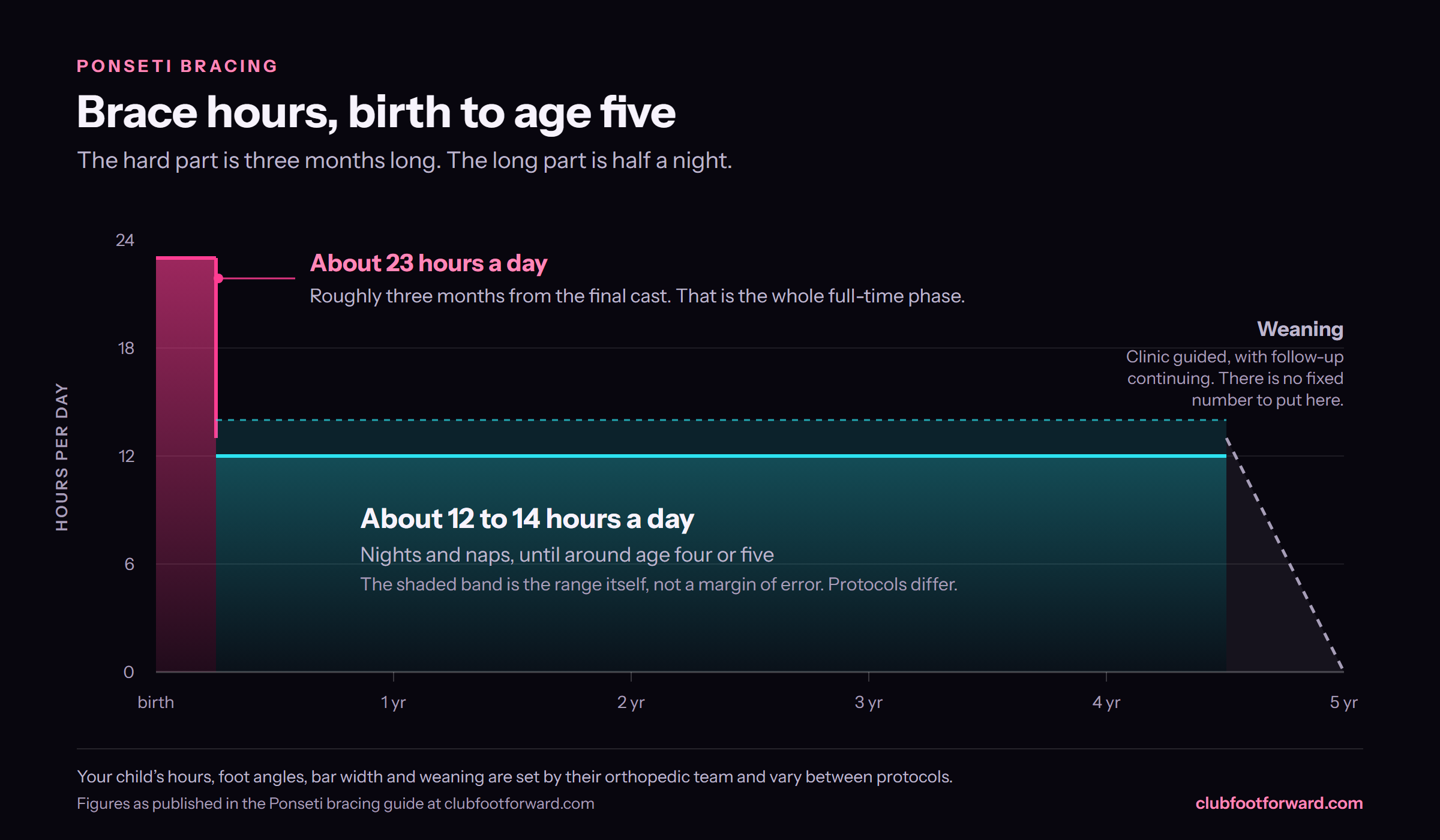
Protocols vary, sometimes considerably. These are common patterns, not your prescription. Your clinic sets the hours, the angles and the bar width, and where they differ from this page, they are right and this page is general.
Why it continues after the foot looks fine The single most common reason families quietly stop. For you1 min
By the time bracing starts, the foot usually looks entirely normal. That is exactly the problem. It makes years of a brace feel like treating something that is already fixed.
But a corrected clubfoot has a strong tendency to drift back during growth, and nothing about the appearance tells you whether that tendency has gone. It has not. The brace is not treating the foot’s appearance; it is holding a position against years of growth.
Casting corrects. Bracing maintains. Stopping when the foot looks normal is stopping halfway.
The first two weeks It is genuinely bad, it is genuinely temporary, and it has a shape. For you2 min
Most babies protest hard for one to two weeks and then stop noticing. The objection is usually to the bar restricting independent kicking instead of to pain, legs that moved separately now move together.
What helps: same point in the routine every night, boots on before the last feed and not after, and keeping the whole thing boring. What does not help is treating it as the emotional center of the evening, because babies read that.
If it is still this hard at week four, that is a signal, not bad luck. Check fit and skin, and go to brace troubleshooting.
Putting it on correctly Heel first. Almost every brace problem traces back to this. For you1 min
Seat the heel
Press it firmly down into the boot before touching a single strap. If the heel is not down, nothing else you do will work.
Middle strap first
Fasten it to hold the heel in place, then do the others. Straps in the wrong order lift the heel back out.
Check the mark
Many clinics mark the sock or boot so you can see at a glance whether the heel has crept. If yours has not, ask.
Missed nights, honestly What actually matters is the pattern, and hiding it is the real risk. For you1 min
One missed night is not a relapse. Illness, travel, a night that fell apart, these happen to everyone doing this for years. Go back to the schedule the next night, and do not add hours to compensate.
What matters is the trend. Hours quietly sliding, nights increasingly skipped, a routine slowly collapsing. That is the pattern tied to relapse, and it is worth naming out loud at the next appointment instead of managing privately. Clinics are not surprised by it, and they can only help with what they know about.
Outgrowing the boots Faster than you think, especially during growth spurts. For you1 min
The bar width and the foot angles are part of the prescription, not adjustable at home. If something needs changing, that is a clinic visit.
When it is the foot, not the brace One distinction worth carrying through the whole phase. For you1 min
A brace getting harder to tolerate is usually fit, growth or routine. A foot getting harder to position is something else. And it is the earliest sign families tend to notice before anyone says the word relapse.
If a boot that went on fine last month now meets resistance, that is a phone call, not a technique problem. See normal tightness vs relapse and relapse prevention.
0 of 7 opened
One clubfoot, two boots
Does the brace harm the good foot?
Families with one clubfoot watch a healthy foot go into a boot every night for years, and reasonably ask what it costs. The studies so far are reassuring.
In children with one clubfoot followed to age sixteen, the unaffected foot of braced children loaded slightly differently at age two. By age five the difference had gone, and there was none at sixteen.9 In 78 children examined at around nine years old, the uninvolved leg showed small rotational differences from typical children, with no effect on foot position or loading, and the authors judged them clinically insignificant.10
Both are small studies. Neither suggests leaving the good foot out: the two-boot abduction brace is what holds the correction on the other side.
People also ask
Bracing questions
One practical thing that catches families out in the first couple of weeks with the bar: it changes how a baby is carried and seated, and not every carrier accommodates it. Carriers that work around boots and bar covers the ones that do.
Whichever brace you were handed has a name on it, and they are not interchangeable. The designs compared covers all nine, or go straight to the Mitchell, the Markell or the Dobbs bar.
Does the brace correct the foot?
Can my child walk in it?
Will bracing delay walking?
How do I know the brace still fits?
Is the bar width important?
How many hours a day is the clubfoot brace worn?
How long does boots and bar bracing last?
What happens if we stop bracing early?
Can my child walk in the boots and bar?
What if we miss brace nights?
Does the brace hurt the unaffected foot?
Sources
Where this comes from
Living with it
The practical pages
Parents often ask whether an SMO can stand in for the bar. It cannot, and SMO alternatives explains why.