
The phase where the difference lives
Three things stack up here at once: a smaller calf, a stiffer lever, a lengthened tendon. Almost every measurable asymmetry in a clubfoot runner traces back to this quarter-second.

Turn these over
Seven things said about push-off
Some are mechanically true, some are coaching folklore that costs people months.
“Weak push-off is just a weak calf.” See what holds
The calf is the most obvious contributor and not the only one. Propulsion needs a strong muscle pulling through a mobile ankle onto a foot rigid enough to push against, and a treated clubfoot (congenital talipes equinovarus, or CTEV) is usually short on all three counts.
That matters practically: someone who trains only the calf and sees limited return has often hit the lever, not the motor. The foot cannot form the stiff structure that converts calf force into forward movement.
“You can train it back to normal.” See what holds
The muscle is structurally smaller from birth and its ceiling is lower. What is also true is that a calf nobody has ever trained has room to improve. How much room, in an adult clubfoot, nobody has measured.
Expect meaningful improvement in repetitions, endurance and how long the pattern holds. Do not expect the two sides to match, and do not treat matching as the measure of success.
“It is making me slower.” See what holds
Reduced propulsion on one side gets compensated for: by the other leg, by the hips, by a higher cadence. The pace can largely survive. What does not survive is the energy budget.
So the honest description is not that you run slower but that you pay more for the same pace, and the bill arrives as fatigue during and soreness afterwards instead of as a worse time.
“I should focus on toeing off harder.” See what holds
Deliberately pushing harder at the end of stance is a common coaching cue and a poor one here. It can lengthen the time on the ground and push more load through a hindfoot that is already the limiting structure, and the midfoot and forefoot are where that load tends to be felt.
The productive version is to reduce what push-off has to achieve (shorter stride, higher cadence) and build the strength off the run instead.
“My good leg is fine, so it is not doing extra.” See what holds
When one side propels less, the other contributes more of the forward drive. That can make the unaffected leg the one that aches after long runs, which baffles people who expected symptoms on the other side.
It is also why training only the affected side misses half the problem. The compensating leg is doing more work and deserves the same attention.
“Carbon-plated shoes are marketing.” See what holds
Whatever the general debate, there is a mechanically specific reason they can help a clubfoot runner: a stiff plate and pronounced rocker do some of the levering that a rigid, poorly-shaped foot cannot do for itself.
They are not universally good. Some people find them unstable on a foot with a narrow base and limited side-to-side control. This is a category where trying a pair beats reading about them.
“A visible limp while running means something is wrong.” See what holds
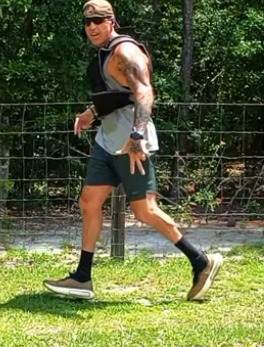
Asymmetric propulsion produces an asymmetric stride. That is the expected result of the anatomy, it is visible on video, and it is not evidence of damage.
What is worth attention is a limp that is new, one that appears with pain, or one that arrives much earlier in a run than it used to. Those are changes; the baseline asymmetry is just how you run.
The three constraints, and what reaches each
| Constraint | What it is | What reaches it |
|---|---|---|
| The motor | A structurally smaller calf, usually untrained | Heavy slow strength work |
| The lever | A hindfoot too stiff to form a rigid push-off platform | Footwear, plate, rocker |
| The tendon | Often lengthened in childhood surgery, so less force at the same effort | Little, structurally |
| The demand | How much propulsion each stride actually needs | Cadence and stride length |
Two rows are trainable, one is buyable, and one is fixed. It is tempting to put all the effort into the first row and read a partial result as failure. The fourth row costs nothing and is the one to try first.
For what one runner’s answers are worth: in September 2026 I filled in a standard foot and ankle outcome questionnaire, the kind researchers use to compare results after foot surgery. On its sport section I marked running, jumping, twisting and kneeling as no difficulty. Squatting was the only item I marked as a problem. That is a fused left hindfoot and two operated feet reporting that running is not the hard part. It does not tell you what it costs me per mile, and no questionnaire asks.
You cannot make the lever stiffer. You can make the motor stronger, and you can ask for less.
The calf specifics (how much size is fixed, how to test where you actually are, what a program looks like) sit on the calf page. What the calf does across a run in particular is on its running page.
People also ask
Propulsion
Do carbon-plated shoes help?
Why is push-off weaker with clubfoot?
Can push-off power be trained?
Does weak push-off slow me down?
Why does my other leg feel like it works harder?
Should I do calf raises before or after running?
Is a visible limp during running a problem?
Sources