
Study 000B Supporting Microstudy
Microstudy B: Preserved Turnover, Suppressed Stride
Home / Research / Microstudy B
Microstudy B examines whether cadence stayed more available than stride length when running moved into a higher-stabilization-demand outdoor context.
The study compares outdoor QC-pass runs against treadmill-expected values at matched speed. The case context is adult bilateral clubfoot (talipes equinovarus outside the United States), but the broader question is how altered biomechanics respond when the running environment becomes less predictable.
The updated finding is sharper than cadence versus stride alone: cadence stayed above expected, stride length stayed below expected, vertical ratio stayed above expected, and both ground contact time and vertical oscillatio were below expected in the later specialized outdoor subset.
Supporting Microstudy: Turnover Held, Stride Compressed, Vertical Ratio Rose From Shorter Stride
Preserved Turnover
In the later specialized outdoor subset, cadence averaged 11.15% above treadmill-expected values.
Suppressed Stride
In the same subset, stride length averaged 10.58% below expected, suggesting reduced distance per step under higher stabilization demand.
Vertical Ratio Context
Vertical ratio was elevated, but vertical oscillation was not. That points toward shortened stride as the likely driver of the ratio increase.
Study Purpose
The Question Microstudy B Was Built to Test
Study 000A showed a turnover-led adaptation pattern. Microstudy A suggested that surface context may matter. Study 000B showed that improved efficiency and persistent internal burden can coexist.
Microstudy B narrows those larger findings into one mechanical question: when the running context becomes less predictable, does the system preserve rhythm better than it preserves stride expression?
The study uses treadmill sessions to estimate expected cadence, stride length, vertical ratio, vertical oscillation, ground contact time, and heart rate at a given speed. Outdoor runs are then compared against those treadmill-expected values.
Main Finding in Plain Language
The later outdoor runs suggest the runner could keep turnover going, but stride length compressed. Cadence stayed above expected. Stride stayed below expected.
The important update is that the elevated vertical ratio does not appear to come from more upward bounce. In the later specialized outdoor subset, vertical oscillation was below expected while vertical ratio was above expected. That makes shortened stride the more likely explanation.
Key Result
Cadence Above Expected, Stride Below Expected
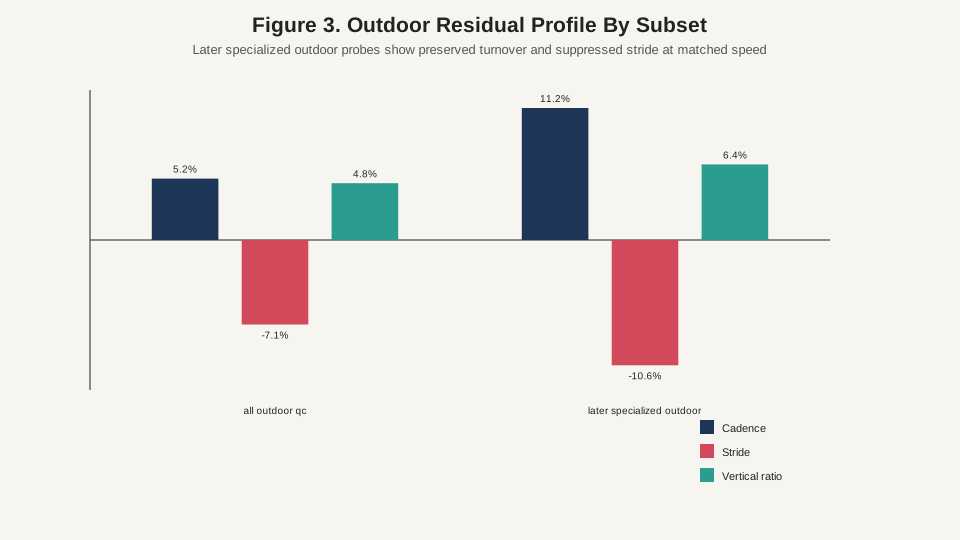
Across all 8 outdoor QC-pass runs, cadence averaged 5.19% above treadmill-expected values, while stride length averaged 7.14% below expected.
The later specialized outdoor subset made the pattern stronger: cadence averaged 11.15% above expected, stride length averaged 10.58% below expected, and vertical ratio averaged 6.39% above expected.
Directionally, the later subset was clean: cadence was above expected in 5 of 5 runs, stride length was below expected in 5 of 5 runs, and vertical ratio was above expected in 5 of 5 runs.
Updated Finding
The Higher Vertical Ratio Looks Stride-Driven, Not Bounce-Drive
The updated analysis adds an important adjacent-metric check. In the later specialized outdoor subset, ground contact time was below expected in 5 of 5 runs and vertical oscillation was below expected in 5 of 5 runs, while vertical ratio was above expected in 5 of 5 runs.
That combination changes the interpretation. If vertical ratio rises while vertical oscillation falls, the ratio increase is less consistent with extra bounce and more consistent with the denominator shrinking: stride length compressed.
In plain terms: the runner was not simply bouncing more outdoors. The runner was covering less distance per step while still maintaining a high turnover pattern.
Study Summary
What Microstudy B Found
All Outdoor QC Runs
Across 8 outdoor QC-pass runs, cadence averaged 5.19% above treadmill-expected values and stride averaged 7.14% below expected values.
Later Outdoor Subset
The later 5-run outdoor subset showed a stronger signature: cadence +11.15%, stride -10.58%, and vertical ratio +6.39% relative to treadmill-expected values.
Adjacent Metric Check
Ground contact time and vertical oscillation were both below expected in 5 of 5 later outdoor runs, supporting a stride-compression interpretation.
Interpretive Finding
The System Preserved Rhythm Before Distance Per Step
Cadence and stride length both contribute to running speed, but they do not respond the same way under constraint. Microstudy B suggests cadence remained available even when stride expression compressed.
That gives the research archive a more specific mechanical interpretation. Higher stabilization demand may not simply make running slower. It may change which part of the running system stays available first.
The updated adjacent-metric finding strengthens that interpretation because elevated vertical ratio appears tied to shorter stride instead of increased vertical motion.
Modeling Approach
How the Comparison Was Made
The study used treadmill-only descriptive models to estimate expected cadence, stride length, vertical ratio, vertical oscillation, ground contact time, and heart rate at a given speed.
Outdoor QC-pass runs were then compared against those treadmill-expected values. This was not a full gait-lab model. It was a within-dataset comparison designed to test whether outdoor running expressed the same speed differently.
Reference Group
Treadmill QC-pass runs formed the descriptive expectation models. There were 179 treadmill runs in the reference model.
Comparison Group
Outdoor QC-pass runs were tested against treadmill-expected expression at matched speed. The outdoor set included 8 total runs.
Validation Checks
Nearest-speed pairing, speed-band matching, sign tests, and bootstrap summaries were included to test whether the directional pattern held beyond the main fitted comparison.
Anchor Cases
Two Outdoor Runs That Show the Patter
The anchor cases show the same basic signature: cadence above expected, stride below expected, and vertical ratio above expected.
April 16, 2025
This 10.23-mile outdoor run showed cadence +5.91%, stride -7.89%, and vertical ratio +5.15% relative to treadmill-expected values.
April 9, 2026
This 5.45-mile outdoor run showed cadence +10.22%, stride -9.28%, and vertical ratio +7.11% relative to treadmill-expected values.
Pattern Meaning
The later anchor suggests the outdoor signature persisted even after running specialization had developed.
Research Disclosure
Study Information and Transparency Statement
Microstudy B was independently designed, conducted, analyzed, and published by Heath, founder of Clubfoot Forward. It uses the researcher’s own activity and running data.
No university, hospital, research institution, commercial sponsor, grant funder, or outside organization participated in this work.
Researcher
- Researcher: Heath
- Organization: Clubfoot Forward
- Role: Founder, independent researcher, and dataset owner
- Case context: Adult with bilateral congenital clubfoot
Study Design
- Study type: Supporting patient-led microstudy
- Related studies: Study 000A and Study 000B
- Sample size: n = 1
- Primary frame: Preserved turnover and suppressed stride expression
- Status: Completed
Oversight
- Funding: None
- Institutional affiliation: None
- Commercial sponsorship: None
- External oversight: None
- Peer reviewed: No
Read the Microstudy
Microstudy B Files
These files are hosted from the public Microstudy B archive. Start with the abstract or plain-language summary, then review the full manuscript, methods, results, discussion, and limitations.
Quick Read
Full Sections
Audit and Replicatio
Figures
Microstudy B Figures
These figures summarize speed-cadence context, speed-stride context, and the outdoor residual profile.

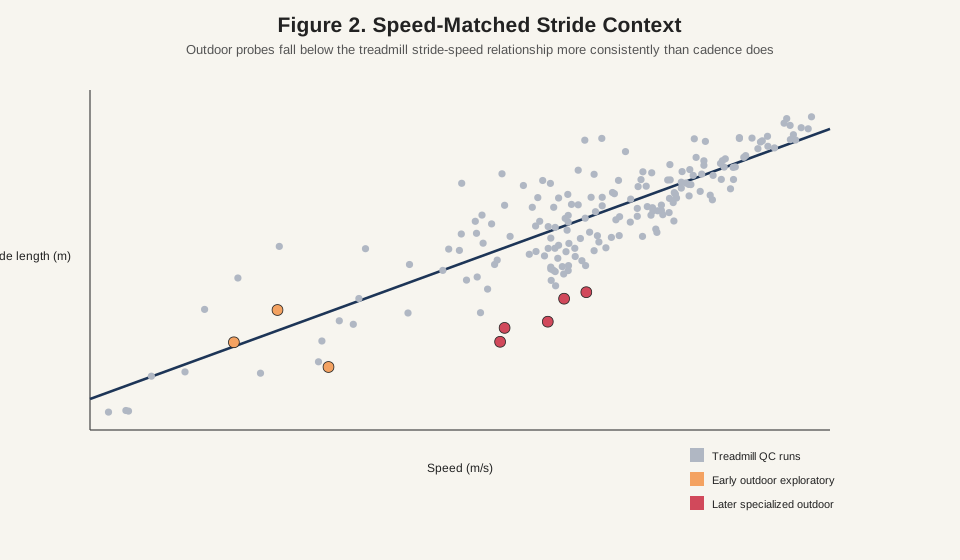
Figure 03
Outdoor residual profile, including the updated adjacent-metric context.
Downloads, Source Tables, and Derived Outputs
These files are provided for transparency and review. Source tables represent packaged input data. Derived outputs are processed summaries generated during the Microstudy B analysis.
Source Table
Derived Outputs
Interpretation Guide
How This Microstudy Should Be Read
It Is Mechanically Specific
Microstudy B does not repeat the full adaptation story. It narrows the question to cadence, stride length, vertical ratio, vertical oscillation, ground contact time, and outdoor residual behavior.
It Uses a Proxy
Outdoor versus treadmill is used as a practical higher-versus-lower stabilization-demand proxy, not a controlled surface ladder.
It Is Descriptive
The study supports a directional pattern. It does not prove joint-level mechanism, clinical cause, or universal training recommendations.
Future Research
Questions Microstudy B Leaves Ope
- Would other runners with altered biomechanics show the same cadence-preserved, stride-suppressed pattern?
- Does the same pattern appear across a graded surface ladder: treadmill, track, asphalt, trail, grass, sand, and technical terrain?
- Can clinical gait analysis confirm whether stride suppression reflects stabilization strategy, reduced push-off, limited ankle mechanics, or another mechanism?
- Does preserved turnover reduce perceived instability, or does it increase internal cost?
- How does this cadence-stride pattern interact with Study 000B’s residual heart-rate burden findings?
Related Research
Where Microstudy B Fits
Study 000A
The flagship study that identified turnover-led adaptation and conserved mechanics across the larger record.
Read Study 000AStudy 000B
The companion flagship study examining adaptive efficiency, internal cost, and residual heart-rate burden.
Read Study 000BMicrostudy A
Supporting study examining surface stabilization and lower stabilization-demand contexts.
Read Microstudy ATopical Authority
Related Clubfoot Forward Pages
Running Biomechanics With Clubfoot
Connects cadence, stride length, push-off, dorsiflexion, ground contact, and running efficiency.
Read the biomechanics pageAdult Clubfoot Gait Compensatio
Explains compensation, fatigue, bilateral mechanics, and adult gait behavior.
Read the gait pageLimited Dorsiflexion and Running
Explains how ankle motion limits can affect stride, rollover, compensation, and running mechanics.
Read the dorsiflexion pageCommon Questions About Microstudy B
What is Microstudy B about?
Microstudy B examines whether cadence remained more preserved than stride length under an outdoor higher-stabilization-demand proxy.
What was the updated finding?
The updated finding is that elevated vertical ratio appears more consistent with shortened stride tha increased bounce because vertical oscillation was below expected while vertical ratio was above expected.
Is this a separate flagship study?
No. It is a supporting microstudy. It refines a mechanical pattern connected to Study 000A, Study 000B, and Microstudy A.
Does this prove outdoor running is bad?
No. The study does not prove outdoor running is bad or unsafe. It describes a pattern in one dataset.
Why does vertical ratio matter here?
Vertical ratio stayed above treadmill-expected values while stride length stayed below expected. The updated adjacent-metric check suggests that the ratio increase was likely stride-driven.
Can this apply to every adult with clubfoot?
No. This is a single-subject patient-led analysis. It should be used to raise research questions, not to generalize outcomes.
Critical Disclaimer
Microstudy B is for education, transparency, and discussion only. It is not medical advice, diagnosis, treatment guidance, clinical gait analysis, peer-reviewed medical research, or population-level biomechanics proof.
Findings should not be generalized to all adults with altered biomechanics, clubfoot, gait compensation, or congenital lower-limb conditions without larger studies, clinical evaluation, matched comparison groups, and independent review.