
Supporting Microstudy | Study 000A Branch | Patient-Led Research
Microstudy A: Did Surface Predictability Matter?
What Question Did This Study Ask?
Was the treadmill-heavy running data in Study 000A only a weakness, or did the predictable surface help make repeatable running possible?
In simpler terms: was the treadmill just where the runs happened, or did the steady surface and controlled setting help the body repeat the running pattern?
Why Ask This?
Because Study 000A showed major running improvement, but much of the later detailed running data came from treadmill sessions. That has to be handled honestly.
A treadmill-heavy dataset can be a limitation because it does not represent every real-world running surface. But for a body with clubfoot-related movement limits, a predictable surface may also matter. Less surprise under the foot can mean less correction work on each step.
What Was the Answer?
The answer was cautious: treadmill dominance was both a limitation and a possible clue. The outdoor comparison group was small, but the outdoor runs generally looked slower, shorter in stride, and higher in vertical ratio.
Vertical ratio is a running metric that compares up-and-down movement with forward movement. Readers do not need to obsess over the number. The simple point is that outdoor running looked less cleanly forward-directed in this record.
Why Does That Matter?
Because the running environment may change what the body can repeat. The study does not say treadmill running is better for everyone. It says surface predictability may have helped this body express running more consistently.
Main Result
The Dataset Was Treadmill-Heavy, and That Matters
The packaged high-resolution dataset included 179 treadmill quality-checked runs and only 8 outdoor quality-checked runs.
That imbalance is important. It means this microstudy cannot make a strong treadmill-versus-outdoor rule for everyone. The outdoor group is too small for that.
But the imbalance is still meaningful. If most repeatable running happened on a predictable surface, that may tell us something about what the body needed in order to keep running consistently.
The right conclusion is not “treadmill good, outdoor bad.” The better conclusion is: surface predictability may have been part of how repeatable running became possible.
Treadmill vs Outdoor Running
This figure shows the surface split and the main surface comparison. It belongs here because the treadmill-heavy dataset is the central issue Microstudy A was built to explain.

Outdoor Context
Outdoor Runs Looked Different, but the Sample Was Small
The available outdoor runs were limited, so this section should be read carefully. This is not a final answer about outdoor running.
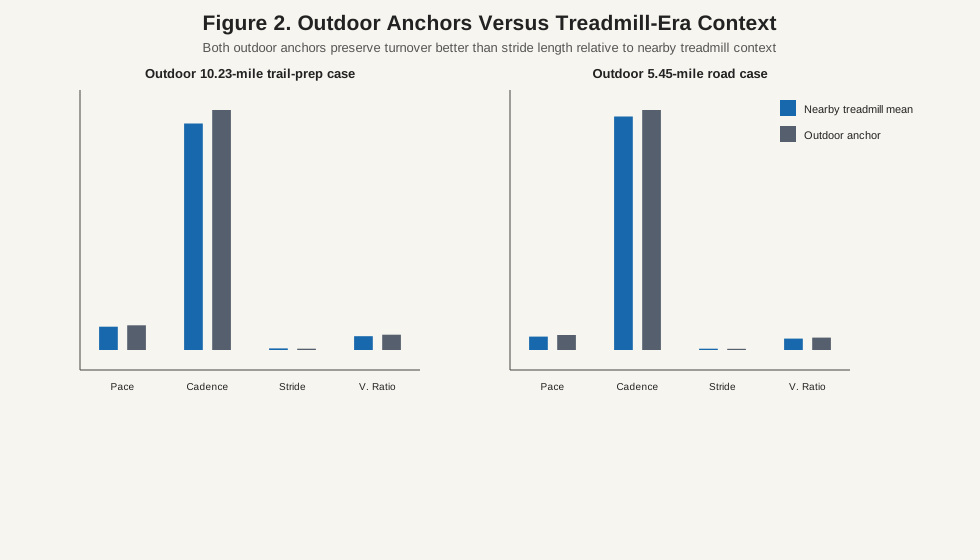
Still, the outdoor runs looked different enough to keep the question alive. They were generally slower, showed shorter stride length, and had higher vertical ratio.
The simple interpretation is that outdoor running may have required more correction work. Uneven ground, small surface changes, turns, slope, and natural pacing changes can all make running harder to repeat for a body that already works around structural limits.
This is why the study treats outdoor running as a signal, not proof. The signal is worth studying. It is not strong enough to become a universal rule.
Outdoor Anchor Context
This figure compares the outdoor anchor context with nearby treadmill sessions. It supports the point that outdoor running looked different, while still needing caution.
Recovery Context
Surface Context May Affect More Than the Run Itself
Microstudy A also checked recovery context around the surface comparison. That matters because a run is not only about what happens during the session.
For a body with movement limits, the cost of a run can show up during the run, after the run, or the next day. A surface that demands more correction may affect how the body absorbs the work.
This study does not prove a recovery rule. It simply keeps the recovery question attached to the surface question. If surface predictability changes how the body runs, it may also change what the body has to recover from.
Recovery Around the Anchor Run
This figure shows the recovery context around the anchor comparison. It is included here because surface demand may matter beyond the run itself.

Evidence Summary
The Numbers That Support the Answer
- 179 treadmill quality-checked runs were available. The detailed running dataset was heavily treadmill-based.
- 8 outdoor quality-checked runs were available. The outdoor group was small, so outdoor findings must stay cautious.
- Outdoor runs were generally slower. That suggests the running context changed performance expression.
- Stride length was generally lower outdoors. Stride reach appeared more limited in the less predictable setting.
- Vertical ratio was generally higher outdoors. In simple terms, outdoor running looked less cleanly forward-directed.
- Step rhythm appeared easier to preserve than stride reach. The body seemed better able to keep rhythm than reach when the setting became less predictable.
What This Means
The Surface Was Not Just Background
Microstudy A matters because it changes how the treadmill-heavy part of Study 000A should be read.
The easy criticism is that treadmill-heavy data are only a limitation. That criticism is fair, but incomplete. For a runner with clubfoot-related movement limits, the treadmill may also represent a more predictable setting where the body had less correction work to do.
That does not mean treadmill running is the answer for everyone. It means surface predictability may be part of the reason this body could repeat running often enough to adapt.
This sets up later research questions about safe working range “operating envelope,” support factors, step rhythm, stride reach, and what happens when running moves into harder environments.
How to Read This Study
What This Study Does Not Prove
This study does not prove treadmill running is better, safer, or preferable for everyone with clubfoot or other movement limits.
It also does not prove that outdoor running is bad. The outdoor group was small, and outdoor running includes many possible differences: surface, slope, turns, weather, pacing, fatigue, and route demands.
The value of this microstudy is that it turns a limitation into a useful question. If most repeatable running happened in a predictable setting, then surface predictability may be part of the adaptation story.
Microstudy A Main Conclusion
Readable conclusion: the treadmill-heavy dataset should be treated as both a limitation and a possible clue. The predictable treadmill setting may have helped repeated running become possible, while the small outdoor group suggested slower pace, shorter stride, and higher vertical ratio.
Technical conclusion: treadmill-versus-outdoor context functioned as a practical stand-in for surface predictability and correction demand, with step turnover appearing more durable than stride expression under the limited outdoor comparison available.
Technical Trail
Want the Full Study Files?
This page is the readable version. The files below are for readers who want the full manuscript, methods, results, audit notes, source tables, figures, and processed outputs.
Read the Study
Inspect the Data
Processed Outputs
FAQ
Common Questions About Microstudy A
What question did Microstudy A ask?
Microstudy A asked whether the treadmill-heavy running data in Study 000A were only a limitation, or whether the predictable surface may have helped make repeatable running possible.
Why did Microstudy A ask that question?
The question mattered because much of the later detailed running data came from treadmill sessions. The study needed to explain whether that was only a weakness or also a clue about surface predictability.
What did Microstudy A find?
Microstudy A found that treadmill dominance should be treated as both a limitation and a possible clue. Outdoor runs were few, but they generally looked slower, shorter in stride, and higher in vertical ratio.
Does Microstudy A prove treadmill running is better?
No. Microstudy A does not prove treadmill running is better, safer, or preferable for everyone.
What does step turnover mean?
Step turnover means how many steps are taken per minute while running. In this microstudy, step rhythm appeared easier to preserve than stride reach when the running context became less predictable.
Can Microstudy A prove what happens for everyone?
No. Microstudy A is based on one person’s running archive and a small outdoor comparison group. It can raise useful questions, but it cannot prove what happens for every person with clubfoot or other movement limits.
Critical Research Disclaimer
Microstudy A is for education, transparency, and discussion only. It is not medical advice, diagnosis, treatment guidance, physical therapy instruction, clinical gait analysis, peer-reviewed medical research, population-level biomechanics proof, training advice, or a universal treadmill recommendation.
The study is a patient-led observational analysis based on available data, supporting records, and lived experience. Findings should not be generalized to all adults with clubfoot, movement limits, gait compensation, joint fusion, or structural abnormality without larger studies, clinical evaluation, matched comparison groups, and independent review.