
Altered Mechanics Flagship Mechanism Study
Study 000G: Cadence Protection Hypothesis
Home / Research / All Studies / Study 000G
Study 000G asks whether cadence behaves like the more preservable running control variable in a altered-mechanics system, while stride behaves like the more sacrificial expression variable under higher stabilization demand.
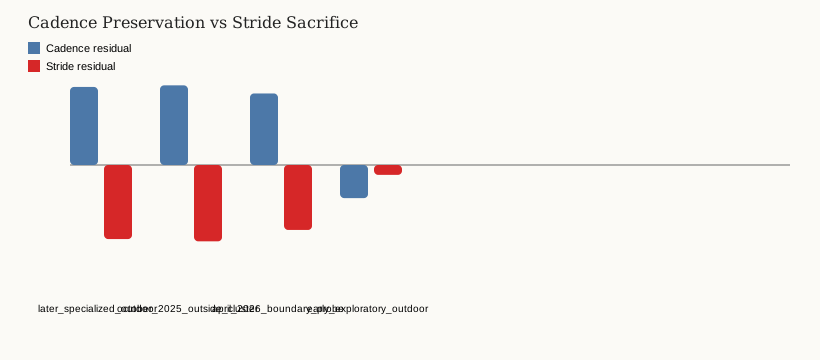
The answer was yes. In the later specialized outside-context probes, cadence stayed above treadmill-expected values in every case, while stride stayed below treadmill-expected values in every case.
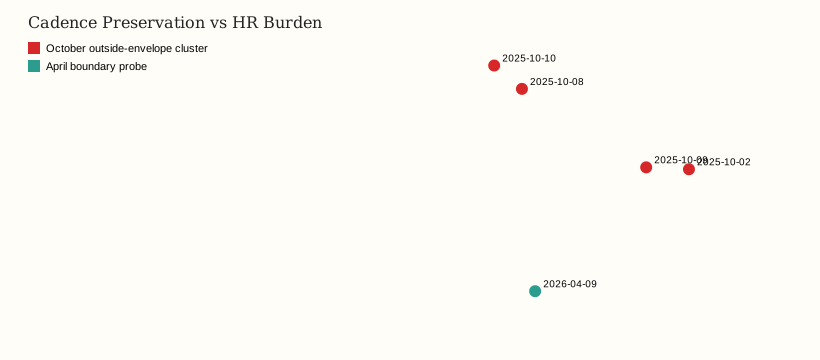
But Study 000G also found something more important: cadence preservation did not automatically protect internal burden. The same cadence-up and stride-down pattern appeared in both high-burden and low-burden outside-surface cases.
Study 000G: Cadence Protection Is Real, but Incomplete
Core Question
Is cadence the preserved control variable, and can preserved cadence fail to fully protect internal burden?
Core Answer
Yes. Cadence behaved like the more preservable control variable, while stride behaved like the more sacrificial expression variable.
Why It Matters
Study 000G separates mechanical preservation from physiological protection. Keeping cadence intact helped preserve running expression, but did not guarantee low burden.
Study Purpose
Why Study 000G Was Needed
Microstudy B suggested that cadence held up better than stride under higher stabilization demand. Study 000E showed that burden rose outside successful context. Study 000F established the operating-envelope construct.
Study 000G connects those findings into a mechanism question: when an altered-mechanics system is pushed toward the boundary of successful expression, does it protect rhythm first and sacrifice stride second?
The study also asks whether that protected rhythm is enough to keep internal burden low.
Plain-Language Finding
The system appeared to protect cadence more than stride.
In plain language: the running rhythm stayed intact, but the amount of ground covered per step compressed. That helped preserve running expression, but it did not fully protect the body from higher internal burden.
This means cadence protection was mechanically real, but physiologically incomplete.
Primary Result
Cadence Stayed Above Expected While Stride Stayed Below Expected
In the later specialized outside-context probes, cadence and stride separated in opposite directions.
Cadence Preservatio
Cadence was above treadmill-expected values i 5 of 5 later specialized outside-context probes.
- One-sided binomial p: 0.03125
- Nearest-speed difference: +16.0 spm
- Speed-band difference: +15.79 spm
Stride Sacrifice
Stride was below treadmill-expected values i 5 of 5 later specialized outside-context probes.
- One-sided binomial p: 0.03125
- Nearest-speed difference: -0.1042 m
- Speed-band difference: -0.0976 m
Burden Persistence
HR residual burden remained positive i 5 of 5 later specialized outside-context probes.
- One-sided binomial p: 0.03125
- Mean HR residual: 12.67 bpm
Mechanism Finding
Cadence Protection Did Not Guarantee Low Burde
The strongest mechanism-level finding is that the same protected-cadence pattern did not guarantee the same burden outcome.
October 2025 Outside-Envelope Cluster
- Mean cadence residual: 11.38%
- Mean stride residual: -10.91%
- Mean HR residual burden: 13.88 bpm
- Burden state: Positive burden
April 2026 Boundary Probe
- Cadence residual: 10.22%
- Stride residual: -9.28%
- HR residual burden: 0.69 bpm
- Burden state: Low burden
Both cases showed cadence-preserved and stride-suppressed mechanics. Only one carried high burden. That means cadence protection alone was not the full burden-protection mechanism.
Mechanism Bridge
The Same Mechanical Pattern Split Into Different Burden States
The October 2025 cluster and April 2026 boundary probe shared the same broad mechanical pattern: cadence preserved, stride suppressed.
But the envelope position and burden state differed sharply. The October cluster sat outside the envelope with low support and positive burden. The April 2026 boundary probe sat closer to supported boundary expression with much lower burden.
This bridge is what made Study 000H necessary. Once cadence protection was shown to be real but incomplete, the next question became: what envelope-support factors determine whether cadence-protected running stays low burden or becomes high burden?
Study 000G’s Main Conclusio
The strongest supported conclusion is:
Cadence behaves like the more preservable running control variable, stride behaves like the more sacrificial expression variable, and cadence preservation alone does not guarantee low internal burden.
Program Meaning
Why Study 000G Changes the Altered-Mechanics Model
Study 000G upgrades the archive from a descriptive cadence-versus-stride pattern into a mechanism model.
The model now suggests that altered-mechanics running may protect rhythm first. Stride length appears more willing to compress under higher stabilization demand. That allows running expression to continue, but it does not fully control the internal cost of that expression.
This matters beyond one diagnosis. Many altered-mechanics systems may preserve a controllable rhythm while sacrificing range, stride, amplitude, or mechanical expression elsewhere.
New Question Created
What Study 000G Opens Next
Study 000G answers the cadence-protection question, but it opens the next mechanism question:
Which envelope-support factors convert a cadence-preserved outside-surface run from high-burden to low-burden expression?
That question became Study 000H: Envelope Support Factors.
Research Disclosure
Study Information and Transparency Statement
Study 000G was independently designed, conducted, analyzed, and published by Heath, founder of Clubfoot Forward. It uses the researcher’s own longitudinal activity and running data, along with packaged outputs from the completed Clubfoot Forward altered-mechanics research archive.
No university, hospital, research institution, commercial sponsor, grant funder, or outside organization participated in this work.
Researcher
- Researcher: Heath
- Organization: Clubfoot Forward
- Role: Founder, independent researcher, and dataset owner
- Case context: Adult altered-mechanics system, originating from bilateral congenital clubfoot
Study Design
- Study type: Flagship mechanism study
- Primary frame: Cadence protection hypothesis
- Key comparison: Cadence residuals, stride residuals, and HR residual burden across outside-context cases
- Sample size: n = 1
- Status: Completed
Oversight
- Funding: None
- Institutional affiliation: None
- Commercial sponsorship: None
- External oversight: None
- Peer reviewed: No
Read the Study
Study 000G Files
These files are hosted from the public Study 000G archive. Start with the plain-language summary, then review the manuscript, methods, results, discussion, and audit materials.
Quick Read
Full Sections
Audit and Replicatio
Figures
Study 000G Figures

Downloads, Source Tables, and Derived Outputs
These files are provided for transparency, inspection, and review. Derived outputs summarize the Study 000G cadence-protection mechanism analysis.
Derived Outputs
Related Research
Where Study 000G Fits
Common Questions About Study 000G
What is Study 000G about?
Study 000G asks whether cadence behaves like the more preservable running control variable while stride behaves like the more sacrificial expression variable in an altered-mechanics running system.
What was the main finding?
Cadence stayed above treadmill-expected values while stride stayed below expected values in all later specialized outside-context probes.
Does cadence protection guarantee low burden?
No. Study 000G found that cadence protection was mechanically real but physiologically incomplete.
What does stride sacrifice mean?
Stride sacrifice means stride length compressed while cadence stayed relatively preserved, suggesting that rhythm was protected while distance-per-step absorbed more of the demand.
Is this only about clubfoot?
No. Clubfoot is the originating case context, but cadence protection and stride sacrifice are altered-mechanics concepts that may apply to other movement systems shaped by joint limitation, surgery history, asymmetry, chronic stiffness, or long-term compensation.
Is Study 000G peer-reviewed?
No. It is a patient-led observational mechanism study designed for transparency, inspection, and future research question development.
Critical Disclaimer
Study 000G is for education, transparency, and discussion only. It is not medical advice, diagnosis, treatment guidance, clinical gait analysis, peer-reviewed medical research, or population-level biomechanics proof.
This study is a patient-led mechanism analysis based on available data and lived experience. Findings should not be generalized to all people with altered mechanics, joint limitations, clubfoot (club foot, talipes), gait compensation, or stabilization-demand differences without larger studies, clinical evaluation, matched comparison groups, and independent review.