
Altered Mechanics Flagship Follow-Up Study
Study 000E: Burden Outside Successful Context
Home / Research / All Studies / Study 000E
Study 000E asks whether internal burden rises when an altered-mechanics running system is pushed outside the narrowed context where successful running expression had been established.
This study builds from Study 000D, which supported selective expression instead of broad normalization. If successful expression became narrower, Study 000E asks whether that narrowing had a measurable consequence: did session-level burden increase when running was expressed outside the supported context?
The answer was yes at the session level. Later outside-context probes showed substantially higher heart-rate residual burden than both the late narrowed-context window and the early comparison window.
Study 000E: Burden Rose Outside the Narrowed Successful Context
Core Question
Does session-level burden rise when an altered-mechanics system has to express running outside its narrowed successful context?
Core Answer
Yes. Later outside-context probes carried higher HR residual burden than the late narrowed-context window and the early comparison window.
Why It Matters
Study 000E gives consequence to selective expression: the successful context was not just different. It appeared less costly at the session level.
Study Purpose
Why Study 000E Was Needed
Study 000A showed long-term adaptation under altered mechanics. Study 000B showed that efficiency improved while unexplained internal burden did not disappear. Microstudy B showed that cadence remained more preserved than stride expression under higher stabilization demand. Study 000D then interpreted the archive as selective expression and not broad normalization.
Study 000E asks the next necessary question: if the system adapted by finding a narrower successful running context, what happens when it has to run outside that context?
The study focuses on session-level burden, using heart-rate residual behavior to test whether outside-context running carried higher internal cost than the narrowed successful context.
Plain-Language Finding
The narrowed successful running context did not just look more stable. It also appeared less costly.
When the system ran outside that supported context, heart-rate burden rose. That means successful expression was not simply about where running happened. It was about whether the run remained inside the system’s supported operating conditions.
Primary Result
The Burden Ladder Increased Outside Successful Context
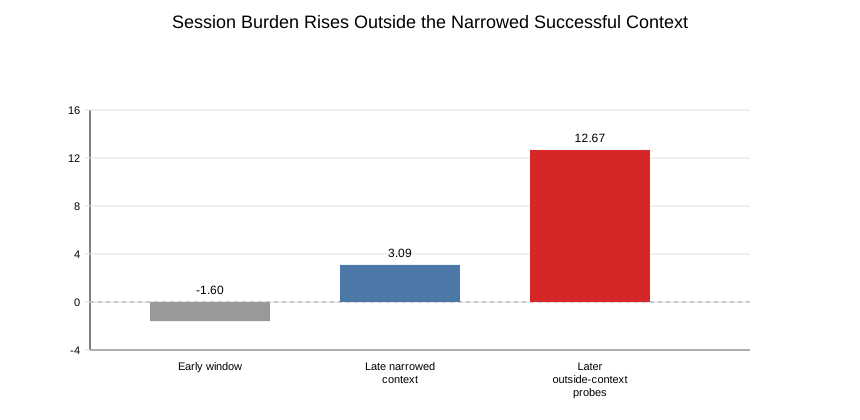
Study 000E found a clear burden ladder across the program contexts.
Early QC Window
Mean HR residual burden was -1.60 bpm.
Late Narrowed Context
Mean HR residual burden was 3.09 bpm.
Outside-Context Probes
Mean HR residual burden was 12.67 bpm.
The later outside-context probes were 9.58 bpm above the late narrowed-context mean and 14.27 bpm above the early comparison window.
Key Result
All Later Outside-Context Probes Were Positive
All 5 of 5 later outside-context probes showed positive HR residual burden.
- Mean HR residual: 12.67 bpm
- Bootstrap interval: 6.19 to 18.37 bpm
- One-sided sign test: p = 0.03125
This was the cleanest burden finding in Study 000E. It supports the conclusion that session-level burden rose when running was expressed outside the narrowed successful context.
Matched Reference Check
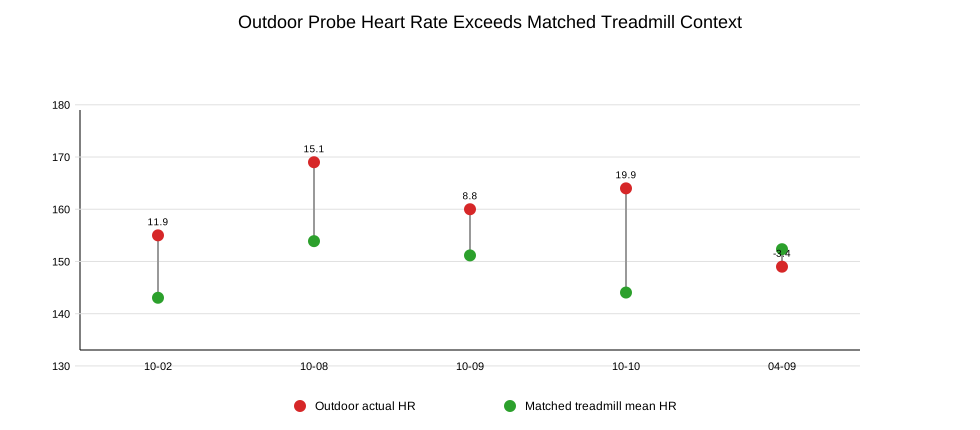
Outside-Context Runs Were Also Higher Than Matched Treadmill References
The study also compared each outside-context probe against local treadmill runs withi +/- 0.10 m/s of speed.
Across the 5 later probes, outside-context heart rate was higher than matched treadmill mean heart rate i 4 of 5 cases. The mean outdoor-minus-matched-treadmill heart-rate difference was 10.50 bpm.
This matched comparison was directionally supportive on average, but less uniform than the residual-burden ladder. For that reason, the strongest answer in Study 000E comes from the session-level residual-burden pattern instead of treating matched treadmill comparison as the entire conceptual frame.
Probe Detail
The Later Outside-Context Probe Patter
October 2, 2025
HR residual was 12.00 bpm, with outside-context heart rate 11.95 bpm above matched treadmill mean.
October 8, 2025
HR residual was 18.06 bpm, with outside-context heart rate 15.11 bpm above matched treadmill mean.
October 9, 2025
HR residual was 12.60 bpm, with outside-context heart rate 8.84 bpm above matched treadmill mean.
October 10, 2025
HR residual was 20.59 bpm, with outside-context heart rate 19.95 bpm above matched treadmill mean.
April 9, 2026
HR residual was only 0.10 bpm, making this the key exception case that later helped create the operating-envelope question.
Interpretive Value
The October cluster carried strong positive burden, while April 2026 raised a sharper boundary question: outside-context mechanics may not always produce the same burden magnitude.
Exception Case
Why April 2026 Matters
The April 9, 2026 probe remained near zero in HR residual burden even though it still showed outside-context mechanics. That matters because it prevents the study from collapsing into a simple binary claim.
The October 2025 outside-context probe block was strongly positive. The April 2026 probe was isolated and low-burden. That contrast suggests that burden may depend on state, sequencing, local support, or operating envelope position and not environment label alone.
This is why Study 000E did more than answer a burden question. It also helped create the next major theory question: should successful context be understood as an operating envelope instead of as a simple place or surface?
Confound Check
Hybrid-Cardio Confounding Remained Cleared
Study 000C identified hidden GPS-bearing hybrid cardio sessions and corrected the early ecology interpretation. Study 000E therefore checked whether the later outdoor probe burden could collapse into immediate hybrid-cardio explanation.
It did not. The later outside-context probes were 69 to 109 days away from the later hybrid-cardio block identified in Study 000C.
That separation supports reading the later outside-context probes as running-burden signals and not immediate hybrid-circuit artifacts.
Recovery Layer
Next-Day Burden Was Reviewed but Not Treated as the Main Result
Study 000E reviewed next-day context, including resting heart rate, sleep score, HRV, and next-day running patterns. However, the October outdoor probe block contained consecutive run days.
That made next-day interpretation less clean than the session-level burden result. The study therefore keeps the strongest claim focused on session-level burden.
This restraint matters. Study 000E supports a strong session-level answer, while leaving cleaner next-day recovery burden as a future research question.
Study 000E’s Main Conclusio
The strongest supported conclusion is:
Session-level burden rises when the altered-mechanics running system is forced outside its narrowed successful context.
Program Meaning
Why Study 000E Strengthens the Altered-Mechanics Model
Study 000E gives consequence to the selective-expression model. Study 000D showed that adaptation was selective, not broadly normalizing. Study 000E shows that leaving the successful context carried a measurable burden cost.
That shifts the program away from a simple surface story and toward a broader altered-mechanics theory: successful expression may depend on staying inside supported operating conditions.
This concept may matter beyond clubfoot (CTEV). A runner with joint limitation, surgery history, chronic stiffness, asymmetry, fusion, arthritis, or long-term compensation may also perform better inside a narrower supported context and experience higher burden outside it.
New Questions Created
Questions Study 000E Leaves Ope
- Does next-day recovery burden rise as cleanly as session-level burden outside the successful context?
- Why did the April 2026 outside-context probe remain near-zero in HR residual burden?
- Is outside-context burden cluster-dependent or state-dependent instead of simply environment-dependent?
- Should successful context be defined as an operating envelope and not as a simple place or surface category?
- Can cadence remain mechanically preservable while still failing to protect internal burden outside the successful context?
Research Disclosure
Study Information and Transparency Statement
Study 000E was independently designed, conducted, analyzed, and published by Heath, founder of Clubfoot Forward. It uses the researcher’s own longitudinal activity and running data, along with packaged outputs from the completed Clubfoot Forward altered-mechanics research archive.
No university, hospital, research institution, commercial sponsor, grant funder, or outside organization participated in this work.
Researcher
- Researcher: Heath
- Organization: Clubfoot Forward
- Role: Founder, independent researcher, and dataset owner
- Case context: Adult altered-mechanics system, originating from bilateral congenital clubfoot
Study Design
- Study type: Flagship follow-up study
- Integrated sources: Study 000B, Microstudy B, Study 000C, Study 000D
- Sample size: n = 1
- Primary frame: Burden outside narrowed successful context
- Status: Completed
Oversight
- Funding: None
- Institutional affiliation: None
- Commercial sponsorship: None
- External oversight: None
- Peer reviewed: No
Read the Study
Study 000E Files
These files are hosted from the public Study 000E archive. Start with the abstract or plain-language summary, then review the manuscript, methods, results, discussion, limitations, and audit materials.
Quick Read
Full Sections
Audit and Replicatio
Figures
Study 000E Figures
These figures summarize the burden-context ladder and the outdoor-versus-matched-treadmill heart-rate comparison.
Downloads, Source Tables, and Derived Outputs
These files are provided for transparency, inspection, and review. Source tables include packaged outputs from prior studies. Derived outputs summarize the Study 000E outside-context burden analysis.
Derived Outputs
- Burden Sign Tests
- Burden Summary
- Context Burden Summary
- Hybrid Separatio
- Outdoor Probe Details
- Primary Answer
- Scope Claims
Integrated Source Tables
Interpretation Guide
How Study 000E Should Be Read
It Tests Consequence
Study 000E does not simply repeat selective expression. It tests whether leaving the narrowed successful context carried a measurable burden cost.
It Is Session-Level
The strongest finding is session-level burden. Next-day recovery burden remains a future research question.
It Is Not Surface-Only
Outdoor probes are the current operational test case, but the stronger construct is burden outside the successful operating context.
Related Research
Where Study 000E Fits
All Studies
Return to the complete study index for all flagship studies, microstudies, and program synthesis pages.
View All StudiesStudy 000D
The interpretation study that established selective expression as the stronger model than broad normalization.
Read Study 000DStudy 000F
Hypothesis study testing whether successful context is better defined as an operating envelope.
Read Study 000FStudy 000B
Companion flagship study examining adaptive efficiency, internal cost, and residual burden.
Read Study 000BMicrostudy B
Supporting study examining preserved turnover, suppressed stride, and stride-driven vertical ratio.
Read Microstudy BResearch Hub
Return to the main research center page for the broader mission and archive structure.
Return to Research HubCommon Questions About Study 000E
What is Study 000E about?
Study 000E asks whether session-level internal burden rises when running is expressed outside the narrowed successful context in an altered-mechanics system.
What was the main finding?
The main finding was that later outside-context probes carried higher HR residual burden than the late narrowed-context window and the early comparison window.
Does Study 000E prove outdoor running is bad?
No. Outdoor running is the current operational test case, not the entire conclusion. The stronger finding is that burden rose outside the narrowed successful context.
Why does April 2026 matter?
April 2026 was a low-burden outside-context probe. It did not destroy the model; it helped create a stronger question about operating envelopes, state dependence, and boundary conditions.
Is this only about clubfoot?
No. Clubfoot is the originating case context, but burden outside successful context is an altered-mechanics concept that may apply to other movement systems shaped by joint limitation, surgery history, chronic stiffness, asymmetry, or long-term compensation.
Is Study 000E peer-reviewed?
No. It is a patient-led observational follow-up study designed for transparency, inspection, and future research question development.
Critical Disclaimer
Study 000E is for education, transparency, and discussion only. It is not medical advice, diagnosis, treatment guidance, clinical gait analysis, peer-reviewed medical research, or population-level biomechanics proof.
This study is a patient-led follow-up analysis based on available data and lived experience. Findings should not be generalized to all people with altered mechanics, joint limitations, clubfoot, gait compensation, stabilization-demand differences, or congenital/acquired lower-limb conditions without larger studies, clinical evaluation, matched comparison groups, and independent review.