
Study 000A Supporting Microstudy
Microstudy A: Surface Stabilization
Home / Research / Microstudy A
Microstudy A examines one specific caveat from Study 000A: Longitudinal Adaptation Synthesis: whether treadmill-dominant running should be treated only as a limitation, or whether it may also represent a lower stabilization-demand environment that helped make repeated running possible.
The study compares treadmill and outdoor QC-pass running sessions as available surface-context groups. The case context is adult bilateral clubfoot (club foot, talipes), but the question is broader: when movement is mechanically constrained, does environmental predictability change how running is expressed?
The main finding is narrow but useful. The treadmill-heavy dataset should not be dismissed as background noise. It may be part of the adaptation story because surface predictability appears connected to stride expression, vertical ratio, and repeatable training.
Supporting Microstudy: Surface Context, Stability Demand, and Stride Expressio
What It Tests
Whether treadmill-versus-outdoor running can serve as a practical proxy for lower versus higher stabilization demand in the available dataset.
Why It Exists
Study 000A found broad adaptation. Microstudy A asks whether training environment helped shape how that adaptation was expressed.
What It Does Not Prove
It does not prove treadmill running is better, safer, or causal. It identifies a plausible environmental factor that deserves more formal study.
Study Purpose
The Caveat Microstudy A Was Built to Test
Study 000A showed substantial long-term adaptation, but much of the later high-resolution running data came from treadmill sessions. That creates a fair question: was treadmill dominance merely a weakness in the dataset, or did the lower-demand surface context help the running pattern become repeatable?
Microstudy A does not try to answer every surface question. It uses the packaged data available and asks a narrower question: do the treadmill and outdoor sessions show enough difference to treat surface context as meaningful instead of incidental?
The answer is cautious. The evidence supports treating surface context as a possible adaptive resource, not as a final explanation.
Main Finding in Plain Language
Treadmill-dominant running may have helped preserve repeated training by reducing the balance and stabilization demands that come with outdoor surfaces. Outdoor sessions were few, but they showed a different expression: generally slower running, shorter stride length, and higher vertical ratio.
In simple terms: the runner may have been able to keep turning over, but stride expression appeared more limited when the environment became less predictable.
Key Comparison
Treadmill Versus Outdoor Was a Proxy, Not the Final Construct
The study uses treadmill and outdoor labels because those are the available categories in the packaged dataset. But the more important concept is not the machine itself. The stronger concept is stabilization demand.
A treadmill is predictable. Outdoor running can introduce grade changes, visual complexity, unevenness, turns, wind, surface variation, and small corrections that are difficult to capture in simple wearable metrics. Microstudy A uses that difference as a practical starting point.
Lower-Demand Context
Treadmill sessions offered a more consistent surface and pacing environment, which may have reduced the cost of stabilization.
Higher-Demand Context
Outdoor sessions likely introduced more correction demands, even when the run itself was still successful.
Interpretive Limit
Because the outdoor sample was small, the study should be read as a signal-generating analysis, not as a surface-performance rule.
Most Important Patter
Cadence Was More Durable Than Stride Expressio
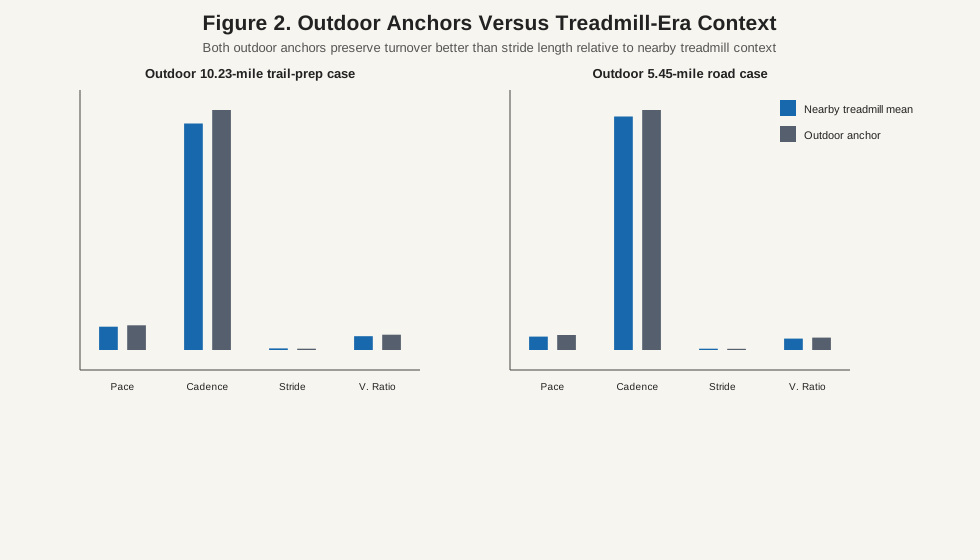
The most useful observation is not simply that treadmill and outdoor runs differed. The more interesting pattern is that cadence appeared to hold up better than stride length when outdoor stabilization demand increased.
In the later outdoor anchor, cadence remained close to or slightly above the treadmill-neighborhood mean, while stride length remained lower and vertical ratio remained higher. That suggests the movement system could preserve turnover more easily than stride expression.
This directly supports a branch question from Study 000A: adaptation may not require every part of the running pattern to improve equally. Some outputs may remain available while others compress under demand.
Research Disclosure
Study Information and Transparency Statement
Microstudy A was independently designed, conducted, analyzed, and published by Heath, founder of Clubfoot Forward. It uses the researcher’s own activity and running data.
No university, hospital, research institution, commercial sponsor, grant funder, or outside organization participated in this work.
Researcher
- Researcher: Heath
- Organization: Clubfoot Forward
- Role: Founder, independent researcher, and dataset owner
- Case context: Adult with bilateral congenital clubfoot
Study Design
- Study type: Supporting patient-led microstudy
- Parent study: Study 000A
- Sample size: n = 1
- Primary frame: Surface context and stabilization demand
- Status: Completed
Oversight
- Funding: None
- Institutional affiliation: None
- Commercial sponsorship: None
- External oversight: None
- Peer reviewed: No
Study Summary
What Microstudy A Found
Dataset Balance
The packaged high-resolution dataset was heavily treadmill-dominant, with 179 treadmill QC-pass runs and 8 outdoor QC-pass runs.
Outdoor Expressio
Outdoor runs were generally slower and showed shorter stride length with higher vertical ratio. That supports a surface-context signal worth preserving.
Study Value
The treadmill dominance in Study 000A should be treated as both a limitation and a possible clue about how repeatable running was achieved.
Read the Microstudy
Microstudy A Files
These files are hosted from the public Microstudy A archive. Start with the abstract or plain-language summary, then review the full manuscript, methods, results, discussion, and limitations.
Quick Read
Full Sections
Audit and Replicatio
Figures
Microstudy A Figures
These figures summarize the surface comparison, outdoor anchor context, and recovery context.
Figure 01
Surface summary across treadmill and outdoor proxy contexts.

Figure 02
Outdoor anchor context compared with nearby treadmill sessions.

Downloads, Source Tables, and Derived Outputs
These files are provided for transparency and review. Source tables represent packaged input data. Derived outputs are processed summaries generated during the microstudy analysis.
Source Tables
Derived Outputs
Interpretation Guide
How This Microstudy Should Be Read
It Supports Study 000A
Microstudy A belongs under Study 000A. It narrows one interpretation instead of replacing the flagship synthesis.
It Uses Practical Categories
Treadmill and outdoor labels are the available comparison groups. They are useful, but they are not the final scientific construct.
It Is Descriptive
The study identifies a pattern worth following. It does not prove causation, safety, or universal training recommendations.
Future Research
Questions Microstudy A Leaves Ope
- Would the same cadence-stride pattern appear in other runners with altered biomechanics?
- How would treadmill, track, asphalt, packed trail, grass, sand, and technical trail compare on a stabilization-demand gradient?
- Does lower stabilization demand change perceived effort, recovery cost, or next-day readiness?
- Can clinical gait analysis confirm whether surface predictability changes stride expression?
- Does cadence remain more durable than stride length when terrain becomes less predictable?
Related Research
Where Microstudy A Fits
Study 000A
The parent flagship study that identified broad adaptation and comparatively conserved mechanics.
Read Study 000AStudy 000B
Companion flagship study examining adaptive efficiency, internal cost, and residual heart-rate burden.
Read Study 000BTopical Authority
Related Clubfoot Forward Pages
Adult Clubfoot Gait Compensatio
Explains compensation, fatigue, bilateral mechanics, and adult gait behavior.
Read the gait pageRunning Biomechanics With Clubfoot
Connects cadence, stride length, push-off, dorsiflexion, ground contact, and running efficiency.
Read the biomechanics pageRunning With Clubfoot
Practical running expectations, pacing, fatigue, adaptation, and training realities.
Read the running pageCommon Questions About Microstudy A
Is Microstudy A separate from Study 000A?
It has its own page and files, but it is a supporting microstudy under Study 000A. It examines one explanatory caveat from the flagship study.
Is this only about treadmills?
No. Treadmill and outdoor running are the available comparison groups. The deeper question is how surface predictability and stabilization demand affect movement expression.
Does this prove treadmill running is better?
No. The study does not prove treadmill running is better, safer, or universally preferable.
What was the most important pattern?
Cadence appeared more durable than stride expression when the running context became less predictable.
Can this apply to every adult with clubfoot?
No. This is a single-subject patient-led analysis. It should be used to raise research questions, not to generalize outcomes.
Critical Disclaimer
Microstudy A is for education, transparency, and discussion only. It is not medical advice, diagnosis, treatment guidance, clinical gait analysis, peer-reviewed medical research, or population-level biomechanics proof.
Findings should not be generalized to all adults with altered biomechanics, clubfoot, gait compensation, or congenital lower-limb conditions without larger studies, clinical evaluation, matched comparison groups, and independent review.