
Flagship Foundation Study | Longitudinal N=1 Archive
Study 000A: Longitudinal Adaptation Synthesis
Study 000A is the foundational flagship page for the research program. It asks the broad six-year question: what changed, what remained comparatively more anchored, and what adaptation pathway does the full record support?
The answer is stronger than “things changed.” The six-year archive supports phased ecological reconfiguration, treadmill-dominant later running specialization, and descriptively turnover-led speed gain inside a documented altered-biomechanics system, while selected movement features remained comparatively more conserved than the main adaptation variables.
This is where the archive first became a real program, not a loose set of observations. Later studies build on this page, but they do not replace it.
Study 000A supports substantial adaptation without claiming broad normalization.
Core Question
Across roughly six years, what changed, what stayed more anchored, and what kind of adaptation pathway does the record support?
Core Answer
The archive supports adaptation through phased reorganization and specialization, not through one uniform mechanical shift.
Why It Matters
This page established that improvement in a constrained system can be substantial while still leaving some movement features more anchored than others.
Plain-Language Finding
The strongest answer is not just that running got better. The entire training system changed.
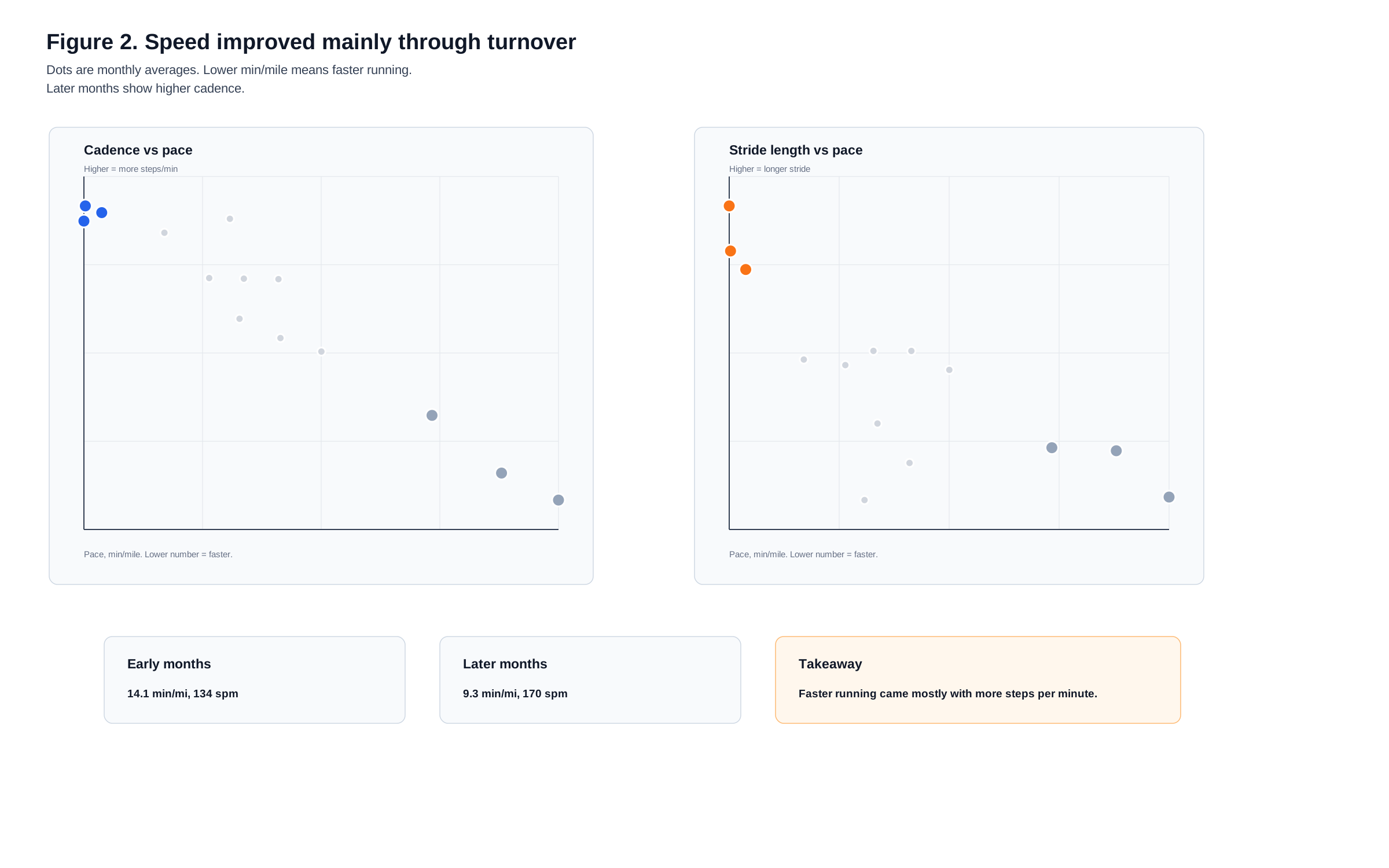
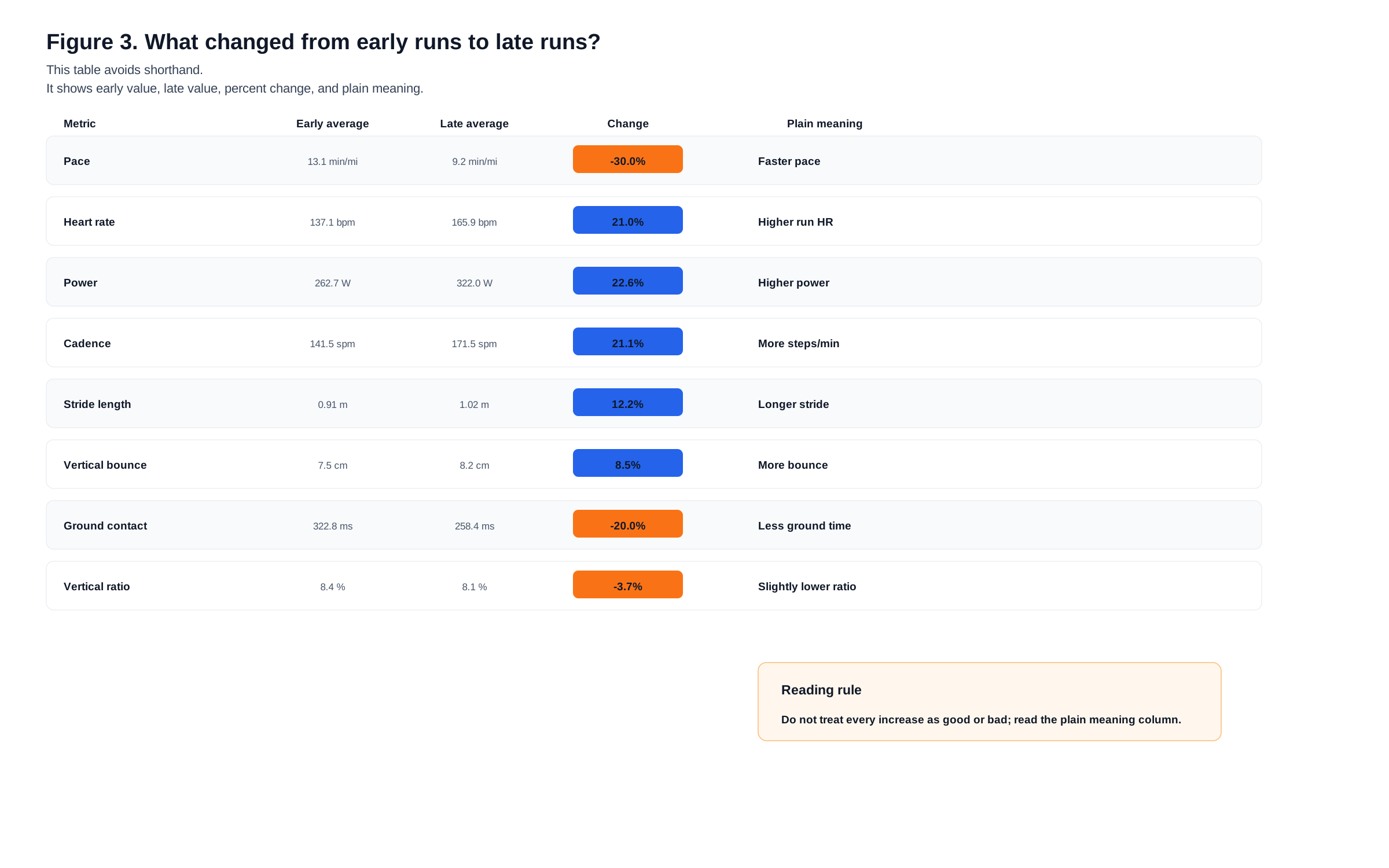
Over six years, activity mix reorganized across clear phases. Later high-resolution running became more specialized, more treadmill-dominant, and substantially faster. Pace improved by 29.99%, cadence increased by 21.15%, stride length increased by 12.24%, and cadence accounted for 62.4% of the cadence-stride speed gain.
At the same time, some movement features changed less than pace, power, cadence, and ground contact time. That is why the main takeaway is phased adaptation plus comparatively conserved mechanics, not simple normalization.
Study Purpose
What Study 000A Was Built To Do
Earlier work could say that some things improved. Study 000A was built to do more than that. It had to answer the flagship question of the archive: what does the full six-year system actually show when treated as one connected adaptation record?
That required looking beyond pace alone. The study examines training ecology, phase structure, recovery context, high-resolution running mechanics, speed-gain decomposition, monthly variability, and the broader relationship between adaptation and specialization.
The result is a foundation page that later studies can refine, challenge, and branch from without forcing the entire archive to start over every time a new mechanism question appears.
Key Findings
What Changed Across The Six-Year Record
Training Ecology Reorganized
The record moved through distinct phases instead of one smooth trend. 2020 was overwhelmingly running-dominant, 2021 through 2024 were more mixed, 2025 pivoted heavily toward conditioning, and 2026 shifted back to strong running dominance.
The Biggest Restructuring Was The Indoor Pivot
The strongest phase restructuring occurred in Indoor Pivot And High-Resolution Adaptation, where indoor share averaged 64.7%.
Later Running Became More Specialized
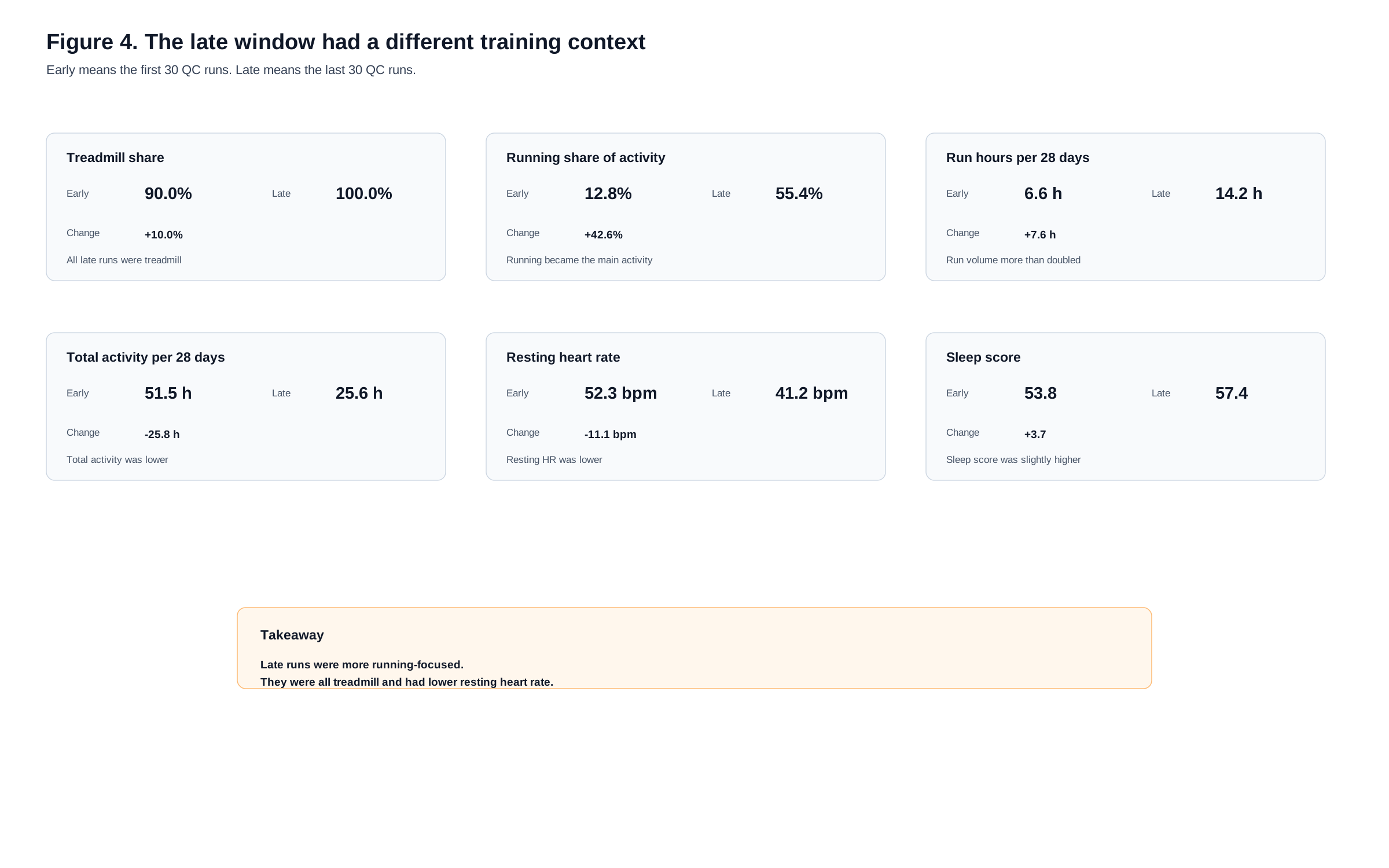
In the high-resolution comparison, the late window was 100.0% treadmill and showed a much larger running share of recent activity than the earlier comparison window.
Running Got Substantially Faster
Comparing the first and last 30 QC-pass runs, pace improved from 13.13 to 9.19 minutes per mile, a -29.99% change.
Cadence Moved More Than Stride
Cadence increased by 21.15% while stride length increased by 12.24%. Cadence contributed 62.42% of the cadence-stride speed gain.
Selected Mechanics Stayed More Anchored
Vertical ratio changed only -3.71% in the early-late contrast and had the lowest monthly coefficient of variation at 2.14%.
Primary Interpretation
The Best-Supported Adaptation Pathway Was Turnover-Led Under Specialization
Study 000A does not claim that one metric stayed “fixed” or that one variable explains everything. The stronger interpretation is more specific and more defensible.
In the later device-supported window, pace tracked cadence at r = -0.9231 compared with r = -0.8205 for stride length. The cadence-stride decomposition showed that cadence carried the larger share of the observed speed gain.
That is why the flagship conclusion is not just “faster running.” It is turnover-led adaptation in a treadmill-dominant specialized context, with selected mechanics remaining comparatively more anchored.
Why It Is Not Just A Running Story
The Whole System Changed, Not Only Pace
One of the most important upgrades in Study 000A is that it stops treating adaptation as a narrow speed story.
Running share of structured hours dropped as low as 21.00% in 2025 and then rose to 84.18% in 2026. Indoor-conditioning share was not static. Total activity and running-specific load did not move together as if they were interchangeable. Recovery context improved in some ways late, even while average running heart rate remained high in the later window.
This matters because the study supports ecological reconfiguration, not just better splits.
Important Audit Refinement
What The Later Audit Tightened Without Overturning
A later raw-summary audit found 7 early-window GPS-bearing hybrid cardio sessions totaling 9.45 miles and 4.99 hours.
That matters because it refines how the early ecology should be described. Garmin indoor-cardio labels did not always mean purely indoor conditioning. The broader ecology was more mixed than the first pass implied.
But the audit did not overturn the core running findings. The phase structure, specialization signal, turnover-led interpretation, and conserved-mechanics framing all survived.
Study 000A Main Conclusion
The strongest supported conclusion is:
Over six years, this documented altered-biomechanics system adapted substantially through phased ecological reconfiguration, treadmill-dominant later specialization, and descriptively turnover-led running change, while selected movement features remained comparatively more conserved than the main adaptation variables.
Why This Study Still Matters Later In The Archive
What 000A Gives The Rest Of The Program
Study 000A gives the later archive three things that never stopped mattering.
A Real Foundation
It establishes that adaptation occurred and that the change was broad enough to require serious interpretation.
A Constraint Clue
It shows that not every variable changed equally, which is one reason later studies could test selective expression, cadence protection, and operating-envelope behavior.
A Scope Boundary
It shows what the archive can support without overclaiming: strong within-subject change and a credible adaptation-pathway interpretation, but not clinical causation or population truth.
Research Disclosure
Study Information And Transparency Statement
Study 000A was independently designed, conducted, analyzed, and published by Heath, founder of Clubfoot Forward. It uses the researcher’s own longitudinal activity and running data as the primary archive.
No university, hospital, research institution, grant funder, or outside organization participated in this work.
Researcher
- Name: Heath
- Organization: Clubfoot Forward
- Role: Founder, independent researcher, and dataset owner
- Case context: Adult with documented altered lower-limb mechanics originating from bilateral congenital clubfoot
Study Design
- Study type: Flagship longitudinal synthesis
- Sample size: n = 1
- Primary frame: Adaptation under structural constraint
- Status: Completed
Oversight
- Funding: None
- Institutional affiliation: None
- Commercial sponsorship: None
- Peer reviewed: No
Read The Study
Study 000A Files
These files are hosted from the public Study 000A archive. Start with the abstract or plain-language summary, then move into the manuscript, methods, results, discussion, audit, figures, outputs, and source tables.
Quick Read
Full Study Sections
Audit And Replication
Figures
Study Figures and Visual Outputs
These figures summarize yearly ecology, adaptation pathways, high-resolution percent change, window context shift, and speed-gain decomposition.


Downloads, Source Tables, And Derived Outputs
These files are provided for transparency, inspection, and review. They include the major source tables and the processed outputs used to support the flagship interpretation.
Source Tables
- Yearly Adaptation Ecology Source Table
- Monthly Adaptation Ecology Source Table
- Fitness Profile Timeline Source Table
- Conserved Mechanics Runs Source Table
- Food and Garmin Overlap Source Table
Derived Outputs
How To Read This Study
What Study 000A Can And Cannot Show
It Can Show Strong Within-Subject Change
Study 000A can describe how this one documented system changed across years, phases, and high-resolution running windows.
It Cannot Prove Population-Level Effects
The study cannot show how every adult with clubfoot or every constrained runner would adapt under the same conditions.
It Cannot Prove Exact Mechanism
The flagship can support a credible adaptation-pathway interpretation, but not exact tissue-level or control-level causation.
It Creates Branch Questions
The later archive grows out of Study 000A because this page identifies the broad pattern while leaving mechanism, burden, and environmental explanation to later work.
Related Research
How Study 000A Connects To The Archive
All Studies
Browse the full study index and see where the flagship foundation sits in the larger tree.
View All StudiesMicrostudy A
Supporting study on surface stabilization and lower stabilization-demand context.
Read Microstudy AStudy 000D
Interpretation study that later argues the archive supports selective expression and not broad normalization.
Read Study 000DCommon Questions About Study 000A
What is Study 000A about?
Study 000A is a six-year longitudinal synthesis examining what changed, what stayed comparatively anchored, and what adaptation pathway the data support in a documented altered-biomechanics movement system.
What was the main finding?
The main finding is that adaptation occurred through phased ecological reconfiguration, treadmill-dominant later specialization, and turnover-led running change while selected movement features remained comparatively conserved.
Does Study 000A prove exact biomechanics?
No. It supports a descriptive adaptation-pathway interpretation, but it does not prove exact biomechanical or clinical mechanism.
Did the later audit overturn the flagship?
No. The later audit tightened the ecology wording by identifying early hybrid GPS-bearing cardio sessions, but it did not overturn the main adaptation findings.
Is this only about clubfoot?
Clubfoot is the documented case context. The broader question is how adaptation behaves when the movement system is structurally constrained and does not simply normalize.
Can these findings apply to every adult with altered mechanics?
No. This is a single-subject study. It may raise useful questions, but it should not be generalized without larger studies, clinical evaluation, matched comparison groups, and independent review.
Critical Disclaimer
Study 000A is for education, transparency, and discussion only. It is not medical advice, diagnosis, treatment guidance, physical therapy instruction, clinical gait analysis, peer-reviewed medical research, or population-level biomechanics proof.
The study is a patient-led observational analysis based on available data, supporting records, and lived experience. Findings should not be generalized to all adults with clubfoot (club foot, or talipes equinovarus), altered biomechanics, gait compensation, joint fusion, or structural abnormality without larger studies, clinical evaluation, matched comparison groups, and independent review.