
Clubfoot Forward Program Synthesis
Study 000C: Full Data Exhaustive Program Analysis
Home / Research / All Studies / Study 000C
Study 000C is a full-program synthesis and data reconciliation study. It combines Study 000A, Study 000B, Microstudy A, and Microstudy B to test whether the completed research program still holds after full-data correction, HYBRID activity review, and expanded ecological analysis.
This study does not replace the earlier studies. It audits them, corrects their ecological context, confirms which claims survived, identifies which claims needed narrowing, and names the next legitimate research questions created by the full archive.
The strongest conclusion is narrower and stronger than the original program: adaptation did not occur by making the system uniformly normal. It occurred through ecological narrowing, later stabilized running specialization, preserved turnover, constrained stride expression, and mixed internal cost.
Program Synthesis: Full-Data Correction, Claim Stability, and Future Research Questions
What Was Audited?
Study 000C reviewed the completed program: Study 000A, Study 000B, Microstudy A, Microstudy B, source tables, outputs, hybrid-session findings, and claim stability.
What Changed?
The early ecology was corrected. Some Garmin indoor-cardio sessions were GPS-bearing hybrid sessions, meaning the early conditioning context was more mixed than originally described.
What Survived?
The core findings survived: phase-structured adaptation, turnover-led gain, conserved mechanics, mixed internal cost, and the Microstudy B outdoor-probe interpretation.
Core Purpose
Why Study 000C Exists
Study 000C was created after the first four completed analyses raised a practical integrity question: does the research program still hold when the full dataset is checked for missed activity context?
The answer is yes, but with a sharper correction. The full-data pass found GPS-bearing hybrid activity hidden under Garmin labels such as indoor_cardio and strength_training. That matters because some earlier wording could be read as if early conditioning was uniformly indoor.
Study 000C corrects that. The early ecology was more mixed than the labels suggested. But the main running findings did not collapse. Instead, the program became more precise: the strongest stabilization-resource claim applies most directly to later running specialization, not to the entire conditioning ecology.
Plain-Language Finding
This was the “did we miss anything?” study. The answer was: yes, something real was found, but no, it did not break the main studies.
The correction was ecological. Some activities labeled as indoor_cardio had GPS traces and looked like hybrid outdoor conditioning. That changes how the early training environment should be described.
The main running findings still held: the system adapted in phases, cadence remained the stronger lever, stride stayed more limited under higher-demand probes, and the internal-cost story remained mixed.
Major Correctio
The HYBRID Data Correctio
The exhaustive review found 18 plausible GPS-bearing indoor_cardio sessions and 4 plausible GPS-bearing strength_training sessions. These sessions matter because they show that Garmin activity labels did not fully describe the actual training ecology.
The early flagship comparison window contained 7 hybrid indoor-cardio sessions totaling 9.45 miles and 4.99 hours. The late flagship comparison window contained 0 hybrid cardio sessions.
This means the early ecology should not be described as purely indoor. It was a mixed conditioning ecology with hidden GPS-bearing hybrid work. The late running-specialization window, however, remained cleanly treadmill-dominant for the running-specific interpretation.
Corrected Ecology
What Changed in the Yearly Ecology
2025
2025 remained a Garmin-labeled conditioning-heavy year, but hybrid GPS cardio accounted for 4.20% of indoor-conditioning hours.
2026
2026 had much less indoor conditioning overall, but hybrid GPS cardio accounted for 26.34% of indoor-conditioning hours.
Why This Matters
The labels were imperfect in both years, but the correction changes context instead of overturning the running-only mechanics conclusions.
Claim Stability
What Did Not Collapse After Full-Data Review
The full-data pass did not overturn the program. The core running findings remained intact after correction.
- Phase-structured adaptation: retained.
- Turnover-led gain: retained.
- Conserved mechanics: retained.
- Mixed internal cost: retained.
- Later running stabilization-resource claim: retained but narrowed.
- Uniformly indoor early ecology: rejected and corrected.
- Microstudy B direct confounding by hybrid cardio: not supported.
Later Outdoor Probes
Why Microstudy B Still Holds
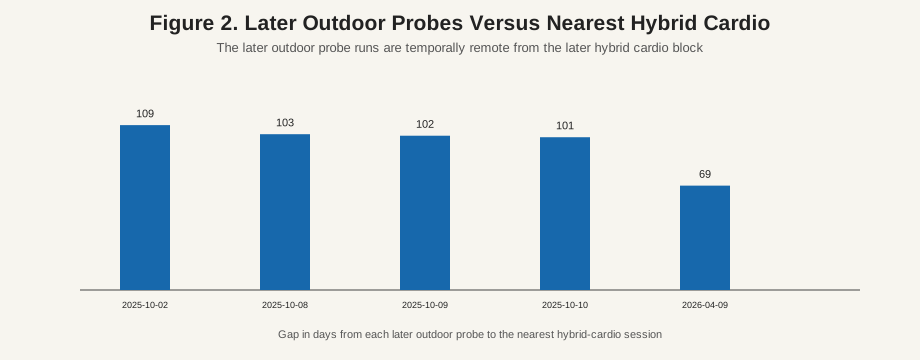
A major possible concern was whether the later outdoor probe runs in Microstudy B were directly confounded by the later hybrid-cardio block. Study 000C tested that concern.
The later outdoor probe runs were 69 to 109 days away from the later hybrid-cardio block. That separation means the outdoor probe runs remain interpretable as running probes and not immediate hybrid-circuit artifacts.
This matters because Microstudy B’s central finding remains meaningful: under a higher-stabilization-demand outdoor proxy, cadence stayed more preserved than stride expression, and elevated vertical ratio appeared more consistent with stride compression than extra bounce.
Integrated Program Model
What the Complete Program Now Says
1. The System Reorganized
The full record does not show a simple straight-line improvement. It shows repeated ecological and functional reorganization across years.
2. Early Ecology Was Mixed
The broader conditioning ecology included hidden GPS-bearing hybrid work, especially within the early comparison context.
3. Late Running Narrowed
The later flagship running window narrowed into a cleaner treadmill-dominant specialization context.
4. Cadence Carried More Speed Gai
Speed gain was assembled mainly through cadence, not large stride expansion.
5. Stride Compressed Under Demand
Higher-demand outdoor probes suggested preserved turnover but reduced stride expression.
6. Cost Did Not Disappear
Efficiency improved in some ways, but unexplained session-level burden remained part of the program.
Most Important Complete-Program Conclusio
If the corrected dataset is forced to make one clear statement, it is this:
Adaptation did not occur by making the system uniformly more normal. It occurred by narrowing the ecology, selecting a more manageable running context, preserving the most accessible mechanical lever, and tolerating a mixed cost profile.
New Research Agenda
Questions Created by Study 000C
Study 000C did more than confirm the program. It created the next layer of research questions.
Ecological Narrowing
Did the system improve partly by selecting a narrower, more manageable training environment rather than broadly normalizing mechanics?
Hybrid Support Ecology
Were GPS-bearing hybrid cardio sessions acting as bridge training, tolerated conditioning, or mechanical compromise work?
2026 Hybrid Use
Why was 2026 indoor cardio proportionally hybrid-heavy even though the late flagship running window remained clean?
Compensation Phenotype
Is ecological narrowing itself part of the compensation phenotype in a nonstandard movement system?
Stabilization Demand and Burde
Does internal burden rise when the system has to express running under higher stabilization demand?
Cadence Versus Stride
Is cadence the preserved control variable while stride is the sacrificed expression variable whe demand rises?
Research Disclosure
Study Information and Transparency Statement
Study 000C was independently designed, conducted, analyzed, and published by Heath, founder of Clubfoot Forward. It uses the researcher’s own longitudinal activity, running, and adaptation data, along with bundled outputs from the completed Clubfoot Forward research archive.
No university, hospital, research institution, commercial sponsor, grant funder, or outside organization participated in this work.
Researcher
- Researcher: Heath
- Organization: Clubfoot Forward
- Role: Founder, independent researcher, and dataset owner
- Case context: Adult with bilateral congenital clubfoot
Study Design
- Study type: Program-level synthesis and full-data audit
- Integrated studies: Study 000A, Study 000B, Microstudy A, Microstudy B
- Sample size: n = 1
- Primary frame: Claim stability, corrected ecology, and future research generatio
- Status: Completed
Oversight
- Funding: None
- Institutional affiliation: None
- Commercial sponsorship: None
- External oversight: None
- Peer reviewed: No
Read the Study
Study 000C Files
These files are hosted from the public Study 000C archive. Start with the abstract or plain-language summary, then review the full manuscript, methods, results, discussion, limitations, and audit materials.
Quick Read
Full Sections
Audit and Replicatio
Figures
Study 000C Figures
These figures summarize corrected HYBRID share and later probe separation from the hybrid-cardio block.
Figure 01
Corrected hybrid share.
Downloads, Source Tables, and Derived Outputs
These files are provided for transparency, inspection, and review. Source tables include prior study outputs, audit tables, HYBRID candidate files, and program-level reconciliation files. Derived outputs summarize the Study 000C analysis.
Derived Outputs
- Claim Stability Matrix
- Corrected Ecology Yearly
- Full Program Model
- Later Probe Hybrid Separatio
- New Content Inventory
- Scope Claims
Audit Source Tables
Integrated Study Inputs
Interpretation Guide
How Study 000C Should Be Read
It Is Not a Microstudy
Study 000C is a program-level synthesis. It audits the full completed archive instead of testing one narrow mechanics question.
It Corrects Context
The HYBRID correction changes how early ecology should be described. It does not overturn the core running findings.
It Creates the Next Questions
Study 000C identifies future directions around ecological narrowing, hybrid support work, cadence-stride strategy, stabilization demand, and internal burden.
Related Research
Where Study 000C Fits
All Studies
Return to the complete study index for all flagship studies, microstudies, and program synthesis pages.
View All StudiesStudy 000A
The foundation longitudinal adaptation synthesis that established the broad adaptation model.
Read Study 000AStudy 000B
Companion flagship study examining adaptive efficiency, internal cost, and residual burden.
Read Study 000BMicrostudy A
Supporting microstudy examining surface stabilization and lower stabilization-demand context.
Read Microstudy AMicrostudy B
Supporting microstudy examining preserved turnover, suppressed stride, and stride-driven vertical ratio.
Read Microstudy BResearch Hub
Return to the main research center page for the broader mission and archive structure.
Return to Research HubTopical Authority
Related Clubfoot Forward Pages
Adult Clubfoot Gait Compensatio
Explains compensation, fatigue, bilateral mechanics, and adult gait behavior.
Read the gait pageRunning Biomechanics With Clubfoot
Connects cadence, stride length, push-off, dorsiflexion, ground contact, and running efficiency.
Read the biomechanics pageLimited Dorsiflexion and Running
Explains how ankle motion limits can affect stride, rollover, compensation, and running mechanics.
Read the dorsiflexion pageCommon Questions About Study 000C
What is Study 000C?
Study 000C is a program-level full-data synthesis that integrates Study 000A, Study 000B, Microstudy A, and Microstudy B after exhaustive data reconciliation.
Did Study 000C overturn the earlier studies?
No. Study 000C corrected the early ecology interpretation but did not overturn the core running findings.
What was the biggest correction?
The biggest correction was that the early flagship window included GPS-bearing hybrid indoor-cardio sessions, meaning the early ecology was more mixed than originally described.
What remained stable?
Phase-structured adaptation, turnover-led gain, conserved mechanics, mixed internal cost, and the Microstudy B outdoor-probe interpretation remained stable.
What new questions did Study 000C create?
Study 000C created new questions around ecological narrowing, hybrid cardio as support ecology, cadence preservation versus stride sacrifice, and stabilization demand versus internal burden.
Is Study 000C peer-reviewed?
No. It is a patient-led observational program synthesis designed for transparency, inspection, correction tracking, and future research question development.
Critical Disclaimer
Study 000C is for education, transparency, and discussion only. It is not medical advice, diagnosis, treatment guidance, clinical gait analysis, peer-reviewed medical research, or population-level biomechanics proof.
This study is a patient-led program-level analysis based on available data and lived experience. Findings should not be generalized to all adults with altered biomechanics, clubfoot (club foot), gait compensation, stabilization-demand differences, or congenital lower-limb conditions without larger studies, clinical evaluation, matched comparison groups, and independent review.