
Clubfoot Forward Flagship Interpretation Study
Study 000D: Selective Expression vs Normalization
Home / Research / All Studies / Study 000D
Study 000D asks the highest-level interpretation question created by the research archive: did the six-year altered-mechanics system adapt by broadly normalizing, or by becoming more selective about where and how successful running could be expressed?
Using packaged outputs from Study 000A, Study 000B, Microstudy B, and Study 000C, this study tested six evidence families: ecological breadth, mechanical gain pathway, higher-demand probe behavior, constraint persistence, internal cost, and robustness after full-data correction.
The answer was clear: all six evidence families aligned more strongly with selective expression than broad normalization. Successful running expression became narrower, more stabilized, more turnover-dependent, and only partially less costly.
Study 000D: Selective Adaptation, Not Broad Normalizatio
Core Question
Did adaptation mean the system became broadly more normal, or did it become more selective about the conditions and levers it could use successfully?
Core Answer
The evidence supported selective expression. The system adapted, but not by normalizing evenly across environments, mechanics, or internal cost.
Why It Matters
Study 000D turns the completed archive into an explicit adaptation model instead of a collection of disconnected findings.
Study Purpose
What Study 000D Was Built to Decide
Study 000A showed that adaptation occurred. Study 000B showed that efficiency improved while internal burden did not disappear. Microstudy B showed that cadence held up better than stride expression under a higher-stabilization-demand outdoor proxy. Study 000C confirmed that the program survived full-data correction.
Study 000D asks what those findings mean together. If the system adapted, was that adaptation broad normalization, or was it selective expression?
The distinction matters. Broad normalization would suggest the system became more typical across contexts. Selective expression suggests something more specific: the system learned where and how it could express running most successfully while some constraints remained.
Plain-Language Finding
Study 000D found that the system did not simply become normal. It became better at expressing running in narrower, more stabilized conditions while relying more heavily on cadence than stride expansion.
In plain language: the body adapted, but it adapted selectively. It found the levers and environments that worked best instead of becoming broadly typical everywhere.
Definitions
Broad Normalization vs Selective Expressio
Broad Normalizatio
Broad normalization would mean the system became more typical across multiple contexts: broader environmental tolerance, more balanced cadence-stride change, reduced constraint signatures, and lower internal burden.
Selective Expressio
Selective expression means the system improved through specific available pathways: narrower successful context, preserved cadence, constrained stride, persistent burden, and stabilized training ecology.
Study 000D Decisio
The evidence supported selective expression across all six tested evidence families.
Primary Result
All Six Evidence Families Favored Selective Expressio
Study 000D tested six evidence families. None favored broad normalization more strongly than selective expression.
- Ecological breadth: later successful running expression narrowed rather than broadened.
- Mechanical gain pathway: speed gain was more cadence-driven than stride-driven.
- Higher-demand probe behavior: cadence stayed above expected while stride stayed below expected.
- Constraint persistence: vertical-ratio behavior remained consistent with persistent constraint.
- Internal cost: efficiency improved, but unexplained burden did not disappear.
- Correction robustness: Study 000C corrected ecology wording without overturning the model.
Evidence Family 1
Ecological Breadth Narrowed
The later system did not show broader successful environmental expression. Instead, running expression became more concentrated and more stabilized.
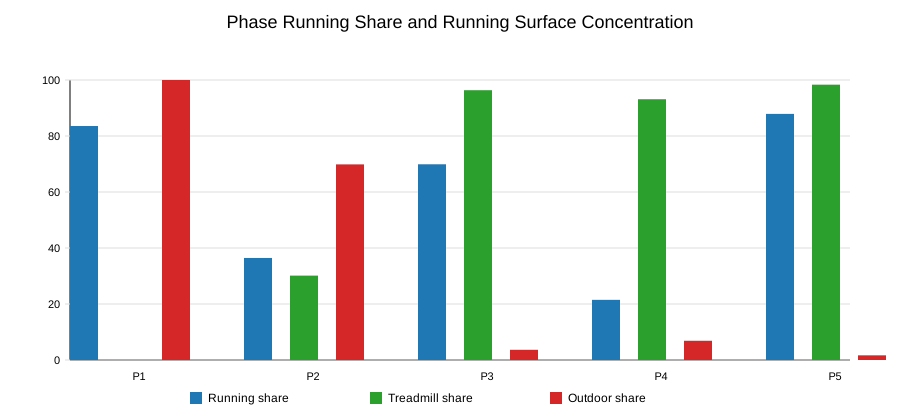
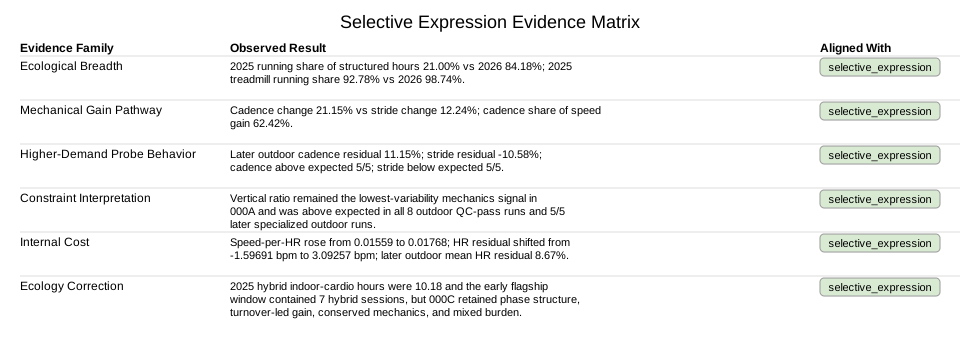
Running share of structured hours rose from 21.00% in 2025 to 84.18% in 2026. At the same time, treadmill running share rose from 92.78% to 98.74%.
That pattern supports environmental concentration, not broadening. The system became more successful inside a narrower running ecology.
Evidence Family 2
The Mechanical Gain Pathway Was Turnover-Led
Study 000D preserved one of the strongest findings from Study 000A: later speed gain was assembled more through cadence than stride expansion.
Speed Gai
Speed increased by 36.11% in the high-resolution comparison.
Cadence Change
Cadence increased by 21.15%.
Stride Change
Stride length increased by 12.24%.
Cadence accounted for 62.42% of cadence-stride speed gain, supporting selective use of an accessible mechanical lever over even mechanical normalization.
Evidence Family 3
Higher-Demand Outdoor Probes Did Not Normalize
Microstudy B provided one of the clearest tests of selective expression. Under the later outdoor higher-stabilization-demand proxy, cadence stayed above treadmill-expected values while stride stayed below treadmill-expected values.
In the later specialized outdoor subset, cadence was above expected i 5 of 5 runs, stride was below expected i 5 of 5 runs, and vertical ratio was above expected i 5 of 5 runs.
That pattern does not support broad normalization across contexts. It supports preserved turnover with constrained stride expression when demand rises.
Evidence Family 4
Constraint Signatures Persisted
Study 000D treats constraint persistence as central. A system can improve substantially while still carrying signatures of structural or mechanical limitation.
Vertical ratio was identified as a low-variability candidate in Study 000A and remained above expected in all 8 of 8 outdoor runs and all 5 of 5 later specialized outdoor runs.
This supports the idea that the system improved through selective expression instead of by removing every constraint signature.
Evidence Family 5
Internal Cost Improved Only Partially
Study 000B showed improved efficiency, but Study 000D uses that finding to clarify the broader model. If the system had broadly normalized, the expectation would be cleaner burden reduction.
Instead, speed-per-heart-rate improved from 0.01559 to 0.01768, while heart-rate residual shifted from -1.60 bpm to 3.09 bpm. Later outdoor mean HR residual was 8.67%.
That is a mixed-cost pattern: better efficiency in some ways, but not burden disappearance.
Evidence Family 6
The Model Survived Full-Data Correctio
Study 000C found hidden GPS-bearing HYBRID activity and corrected the early ecology interpretation. That correction mattered, but it did not overturn the main program.
Phase structure, turnover-led gain, conserved mechanics, and mixed internal burden remained intact after the full-data correction. That robustness strengthened the selective expression interpretation.
Study 000D therefore does not depend on a fragile or uncorrected reading of the archive. It uses the corrected program as the basis for its interpretation.
Study 000D’s Main Conclusio
The strongest supported conclusion is:
The six-year program supports a selective adaptation model and not a broad normalization model. Successful running expression became narrower, more stabilized, more turnover-dependent, and only partially less costly.
Program Meaning
Why This Is Bigger Than a Treadmill Finding
Study 000D does not reduce the interpretation to treadmill versus outdoor running. The stronger construct is selective expression: narrowed successful context, stabilized environment, preserved cadence, constrained stride, and partial internal-cost improvement.
This matters because it moves the research program away from the simplistic idea that successful adaptation must look like convergence toward a standard movement pattern.
Instead, the program suggests that a constrained movement system may adapt by learning where it can express performance most successfully.
Future Research
Questions Study 000D Sets Up
- Is ecological narrowing itself part of a compensation phenotype?
- Is cadence the preserved control variable while stride becomes the sacrificed expression variable?
- Does internal burden rise when the system is forced outside its narrowed successful context?
- Would a graded stabilization-demand ladder show stepwise cadence preservation, stride suppression, and burden change?
- Can other altered-biomechanics systems show selective expression without broad normalization?
Research Disclosure
Study Information and Transparency Statement
Study 000D was independently designed, conducted, analyzed, and published by Heath, founder of Clubfoot Forward. It uses the researcher’s own longitudinal activity and running data, along with packaged outputs from the completed Clubfoot Forward research archive.
No university, hospital, research institution, commercial sponsor, grant funder, or outside organization participated in this work.
Researcher
- Researcher: Heath
- Organization: Clubfoot Forward
- Role: Founder, independent researcher, and dataset owner
- Case context: Adult with bilateral congenital clubfoot
Study Design
- Study type: Flagship interpretation study
- Integrated sources: Study 000A, Study 000B, Microstudy B, Study 000C
- Sample size: n = 1
- Primary frame: Selective expression vs broad normalizatio
- Status: Completed
Oversight
- Funding: None
- Institutional affiliation: None
- Commercial sponsorship: None
- External oversight: None
- Peer reviewed: No
Read the Study
Study 000D Files
These files are hosted from the public Study 000D archive. Start with the abstract or plain-language summary, then review the manuscript, methods, results, discussion, limitations, and audit materials.
Quick Read
Full Sections
Audit and Replicatio
Figures
Study 000D Figures
These figures summarize phase environment, the signature evidence matrix, and yearly running surface share.

Downloads, Source Tables, and Derived Outputs
These files are provided for transparency, inspection, and review. Source tables include packaged outputs from prior studies and derived outputs summarize the Study 000D selective-expression analysis.
Derived Outputs
- Decision Table
- Phase Environment Table
- Primary Conclusio
- Scope Claims
- Signature Evidence Matrix
- Yearly Expression Table
Integrated Source Tables
- Study 000A Phase Model
- Study 000A Speed-Gain Decompositio
- Study 000A Window Change Summary
- Study 000A Yearly Overview
- Study 000B Window Summary
- Microstudy B Adjacent Metric Summary
- Microstudy B Sign Tests
- Microstudy B Subset Summary
- Study 000C Claim Stability Matrix
- Study 000C Corrected Ecology Yearly
- Yearly Adaptation Ecology Source Table
Interpretation Guide
How Study 000D Should Be Read
It Is an Interpretation Study
Study 000D does not simply add another metric. It interprets the completed evidence stack and decides which adaptation model is best supported.
It Is Not a Universal Claim
The study supports selective expression within this dataset. It does not prove that every altered movement system adapts the same way.
It Moves the Program Forward
Study 000D changes the next question from “did adaptation happen?” to “is selective expression a broader adaptation strategy under altered biomechanics?”
Related Research
Where Study 000D Fits
All Studies
Return to the complete study index for all flagship studies, microstudies, and program synthesis pages.
View All StudiesStudy 000A
Foundation study examining long-term adaptation, turnover-led change, and conserved mechanics.
Read Study 000AStudy 000B
Companion flagship study examining adaptive efficiency, internal cost, and residual burden.
Read Study 000BStudy 000C
Full-data synthesis confirming claim stability after HYBRID correction and program reconciliation.
Read Study 000CMicrostudy B
Supporting study examining preserved turnover, suppressed stride, and stride-driven vertical ratio.
Read Microstudy BResearch Hub
Return to the main research center page for the broader mission and archive structure.
Return to Research HubTopical Authority
Related Clubfoot Forward Pages
Adult Clubfoot Gait Compensatio
Explains compensation, fatigue, bilateral mechanics, and adult gait behavior.
Read the gait pageRunning Biomechanics With Clubfoot
Connects cadence, stride length, push-off, dorsiflexion, ground contact, and running efficiency.
Read the biomechanics pageLimited Dorsiflexion and Running
Explains how ankle motion limits can affect stride, rollover, compensation, and running mechanics.
Read the dorsiflexion pageCommon Questions About Study 000D
What is Study 000D about?
Study 000D asks whether the six-year altered-mechanics system adapted through broad normalizatio or through selective expression.
What was the main finding?
The main finding was that all six evidence families aligned more strongly with selective expression than broad normalization.
What does selective expression mean?
Selective expression means the system improved by using specific accessible contexts and mechanical levers instead of becoming broadly typical across all running conditions.
Does this mean the adaptation failed?
No. Study 000D argues the opposite: adaptation was real, but success depended on selectivity rather tha broad normalization.
Is this only about clubfoot?
Adult bilateral clubfoot is the case context. The broader question is how altered biomechanics may adapt under constraint.
Is Study 000D peer-reviewed?
No. It is a patient-led observational interpretation study designed for transparency, inspection, and future research question development.
Critical Disclaimer
Study 000D is for education, transparency, and discussion only. It is not medical advice, diagnosis, treatment guidance, clinical gait analysis, peer-reviewed medical research, or population-level biomechanics proof.
This study is a patient-led interpretation analysis based on available data and lived experience. Findings should not be generalized to all adults with altered biomechanics, clubfoot (congenital talipes equinovarus, or CTEV), gait compensation, stabilization-demand differences, or congenital lower-limb conditions without larger studies, clinical evaluation, matched comparison groups, and independent review.