
Flagship Hypothesis Study | Patient-Led Observational Analysis
Study 000F: Successful Operating Envelope Hypothesis
Study 000F asks whether successful running is better explained by an operating envelope than by surface category alone.
Earlier studies showed that this altered-mechanics system adapted selectively, carried higher burden outside its narrowed successful context, and did not behave like a simple “treadmill good, outdoor bad” story.
Study 000F tests the broader explanation. The strongest answer is that successful running clustered inside a bounded support region: surface mattered, but recent training context, running density, local embedding, mechanical expression, and internal burden also mattered.
This page is written for normal readers first. The full manuscript, methods, source tables, figures, and outputs are linked later for readers who want the technical trail.
The Big Question
Is successful altered-mechanics running better explained by an operating envelope than by treadmill-versus-outdoor category alone?
The Big Answer
Yes. Surface category mattered, but it did not explain the archive as well as the operating-envelope model.
The Key Case
April 2026 was outdoors but low burden, because it was still highly supported by the surrounding running context.
Plain-English finding: successful running was not just about surface. It was about whether the run stayed inside a supported operating range where the body had enough context, rhythm, and recent training support to keep burden lower.
Official Study Snapshot
Study 000F at a Glance
Study Type
Flagship patient-led hypothesis study.
Plain English: this study tests a model, not just one metric.
Integrated Sources
Study 000B, Study 000C, Study 000D, Study 000E, and Microstudy B.
Plain English: this study uses the earlier archive to test the envelope idea.
Primary Test
Operating envelope versus surface category alone.
Plain English: was this more than treadmill versus outdoor?
Main Finding
Operating envelope explained the archive better than surface category alone.
Plain English: surface mattered, but it was not the whole system.
Boundary Case
April 9, 2026 showed low burden despite outdoor mechanics because it was strongly embedded in recent running context.
Plain English: the run was outside by surface, but supported by the envelope.
Research Boundary
Useful as a hypothesis model, not population-level proof.
Plain English: meaningful archive, still one case.
Surface Alone Failed
Outdoor burden was not uniform.
Outdoor heart-rate residual burden ranged from -3.75 bpm to 32.84 bpm.
Boundary Cluster
Low support raised burden.
The October 2025 outside cluster averaged 13.88 bpm residual burden with low recent running support.
Envelope Support
April 2026 stayed protected.
April 9, 2026 had 91.08% running-share context and 32 treadmill neighbors within 21 days.
Visual Summary
Study 000F in One Picture
Study 000F is the theory layer. It asks whether the archive is better organized by operating state than by surface label alone.
Jump To
Plain-English finding | Why this study exists | Glossary | Key numbers | Figure previews | Surface limit | April 2026 boundary | Interpretation | Main conclusion | Transparency | Study files | Downloads | Limits | Related research | FAQ
Plain-English Finding
The Main Finding
Study 000F found that “treadmill versus outdoor” was too simple.
Outdoor running sometimes carried high burden, but not always. The April 2026 boundary case showed that an outdoor run could stay low-burden when it was surrounded by strong running support.
The better explanation is an operating envelope: a supported range where surface, recent running density, mechanical expression, and burden response line up well enough for the body to perform without the same disruption.
Shortest version: the surface mattered, but the operating state mattered more.
Why This Study Exists
The Theory Question Study 000F Was Built to Answer
Study 000D showed selective expression. Study 000E showed that burden rose outside the narrowed successful context. But those findings created a new problem: was this just a surface story?
Study 000F tests that directly. If surface category alone explained the archive, outdoor runs should behave more uniformly. They did not.
The operating-envelope hypothesis gives the archive a better frame. Surface still matters, but it works alongside recent training density, local embedding, mechanical expression, and internal burden behavior.
Glossary
Study 000F Terms in Plain English
These terms are used in this study and across the larger research archive.
Operating envelope
A supported range of conditions where the body can express performance with less disruption or burden.
Surface category
The basic surface label, such as treadmill or outdoor. Study 000F argues this label is useful but incomplete.
Local embedding
The recent training context around a run. A run may be better supported when similar work has been repeated nearby in time.
Treadmill-neighbor density
How many nearby treadmill runs surrounded a probe within a defined time window.
Boundary case
A case that tests the edge of the model and shows whether a simple explanation is enough.
Running-share context
How much of the recent training context was made up of running.
Selective expression
Improvement that appears under specific conditions or through specific movement strategies rather than everywhere equally.
Altered mechanics
A body that moves differently because of structure, surgery, fusion, limited motion, asymmetry, pain, or compensation.
Key Numbers Explained
The Main Results in Plain English
These are the numbers that matter most for Study 000F.
Outdoor residual burden ranged from -3.75 to 32.84 bpm
What that means: outdoor runs did not behave as one uniform group.
Plain English: surface alone could not explain the burden pattern.
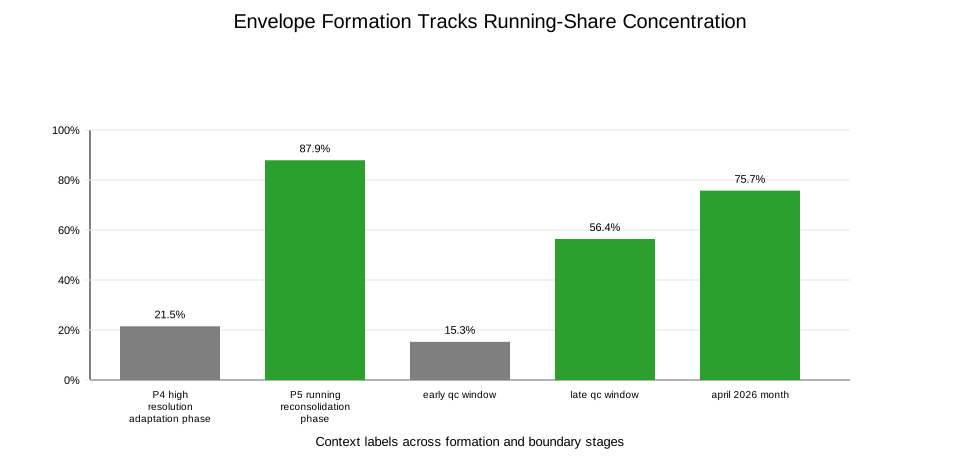
P5 running share averaged 87.90%
What that means: the later reconsolidation phase was heavily running-centered.
Plain English: the system became strongly embedded in running.
P5 treadmill share reached 98.33%
What that means: successful running was highly concentrated in a predictable surface context.
Plain English: the successful region became narrow and repeatable.
October 2025 running share averaged 5.13%
What that means: the high-burden outside cluster had very little recent running support.
Plain English: the system was poorly embedded before those probes.
October 2025 mean residual burden was 13.88 bpm
What that means: burden rose when the system was near the edge or outside the supported envelope.
Plain English: low support plus outside-context demand was expensive.
April 2026 had 32 treadmill neighbors
What that means: the low-burden outdoor boundary case was surrounded by strong recent treadmill support.
Plain English: it was outdoors, but it was not unsupported.
Study Figures
Study 000F Figures, With Plain-English Captions
These figures show the operating-envelope pattern visually for readers who want more than a summary without opening every technical file.
Figure 01: Operating State Burden Scatter
Plain English: this figure shows how burden varied by operating state instead of behaving as a simple surface category.
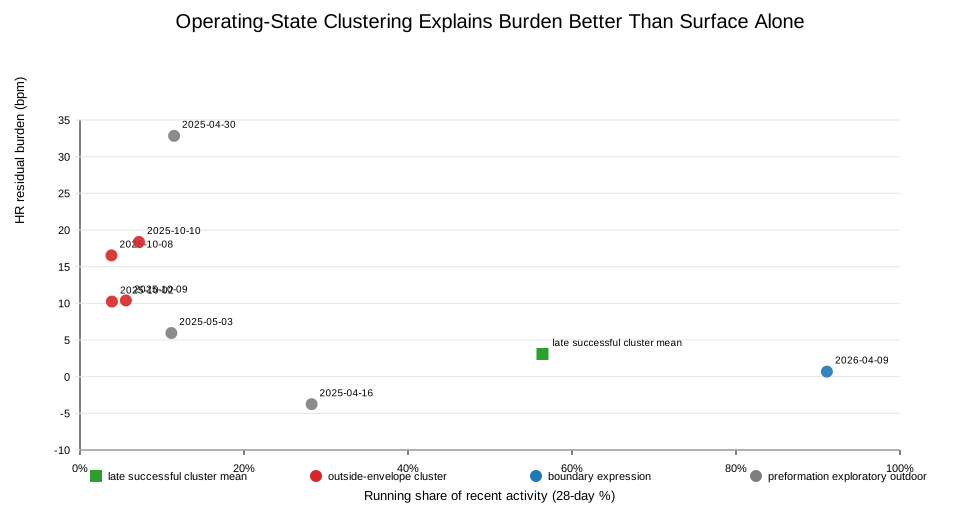
Figure 02: Embedding Versus Burden
Plain English: this figure shows why recent running support mattered to the burden pattern.
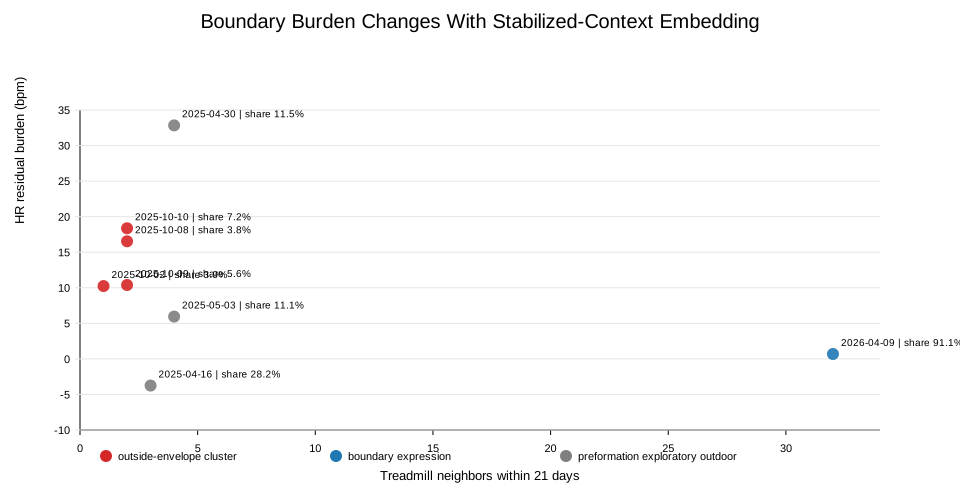
Figure 03: Envelope Formation and Running Share
Plain English: this figure shows how the successful operating region formed as running became more concentrated.
Primary Result
Surface Category Alone Was Not Enough
The cleanest reason Study 000F matters is that outdoor runs did not behave uniformly. Outdoor heart-rate residual burden ranged from -3.75 bpm to 32.84 bpm.
If surface category alone explained the archive, outdoor runs would be expected to behave more consistently. Instead, the same broad label contained very different burden states.
The operating-envelope model explains that better. Surface can push the system toward the edge, but recent running context, local support, mechanical expression, and burden response determine whether the run is actually inside or outside the supported region.
Boundary Case
Why April 2026 Strengthened the Envelope Model
The April 9, 2026 outdoor probe is the most important boundary case in Study 000F.
A simple surface model struggles with it because the run was outdoors but stayed low-burden, with only 0.69 bpm heart-rate residual burden. It also sat -3.35 bpm versus matched treadmill mean heart rate.
The operating-envelope model handles it better. That run occurred inside a highly supported running context: 91.08% running-share context and 32 treadmill neighbors within 21 days.
Practical takeaway: April 2026 was outdoors by surface, but still supported by the broader envelope.
Interpretation
What the Operating Envelope Adds
Operating envelope gives the research program a stronger organizing model than surface category alone.
Instead of asking whether treadmill is always better than outdoor running, Study 000F asks whether an altered-mechanics system has a bounded range where running can be expressed with lower burden.
That model is more useful because it can include surface, recent training density, support context, mechanical behavior, and internal cost. It also explains why two outdoor runs can behave very differently.
Practical takeaway: the question is not only where the run happened. The question is whether the body was inside the supported range where it could handle the work.
Study 000F Main Conclusion
The readable conclusion: the altered-mechanics archive is better explained by a successful operating envelope than by surface category alone. Surface mattered, but the strongest model also required recent running support, local embedding, mechanical expression, and burden response.
The technical conclusion: successful expression clustered inside a bounded support region, and burden rose when the system moved outside that region. The April 2026 boundary case strengthened the envelope model by showing that outdoor mechanics could remain low-burden when strongly embedded inside the broader support context.
Future Research
What Study 000F Opens Next
Study 000F moves the program from interpretation toward measurement. The next question is whether envelope support can be quantified prospectively instead of recognized after the fact.
- Can envelope support be measured before a run using local embedding markers?
- Which matters more: surface, recent running density, treadmill-neighbor density, fatigue state, or mechanical expression?
- Can a graded envelope score predict burden before the run happens?
- Do other altered-mechanics systems show bounded operating envelopes?
- Can the operating-envelope model explain why some outside-context runs are expensive while others remain protected?
Research Disclosure
Study Information and Transparency Statement
Study 000F was independently designed, analyzed, and published by Heath, founder of Clubfoot Forward. It uses my own longitudinal activity and running data, along with packaged outputs from the completed Clubfoot Forward altered-mechanics research archive.
No university, hospital, research institution, grant funder, commercial sponsor, or outside organization participated in the design, analysis, interpretation, or publication of this work.
Researcher
- Name: Heath
- Organization: Clubfoot Forward
- Role: Founder, independent researcher, and dataset owner
- Case context: Adult with long-term altered lower-limb mechanics from bilateral congenital clubfoot
Study Design
- Study type: Flagship hypothesis study
- Integrated sources: Study 000B, Study 000C, Study 000D, Study 000E, and Microstudy B
- Sample size: n = 1
- Primary frame: Successful operating envelope under altered mechanics
- Status: Completed hypothesis study; archive remains active for related updates and linked follow-up studies
Oversight
- Funding: None
- Institutional affiliation: None
- Commercial sponsorship: None
- External oversight: None
- Peer reviewed: No
Technical Files
Study 000F Files for Technical Readers
The page you are reading is the plain-English version. The files below are for readers who want the full technical record: manuscript, methods, results, audit notes, scripts, figures, source tables, and processed outputs.
Quick Read
Full Study Sections
Audit and Replication
Downloads, Source Tables, and Derived Outputs
These files are provided for transparency and review. Most readers do not need these to understand the study. They are here for people who want to audit the data trail, inspect the source tables, or review the processed outputs.
Derived Outputs
- Boundary Cluster Summary
- Boundary Expression Table
- Discovered Questions
- Evidence Family Matrix
- Explanatory Power Matrix
- Meta Summary
- Primary Answer
- Scope Claims
- Success Formation Table
Integrated Source Tables
- Study 000B Run-Level Dataset
- Study 000B Monthly Summary
- Study 000B Window Summary
- Microstudy B Outdoor Cases
- Study 000C Claim Stability Matrix
- Study 000D Phase Environment Table
- Study 000D Yearly Expression Table
- Study 000E Burden Summary
- Study 000E Context Burden Summary
- Study 000E Outdoor Probe Details
How to Read This Study
What Study 000F Can and Cannot Show
It can test a better explanation.
Study 000F can show that operating envelope explains this archive better than surface category alone.
It can preserve surface as one input.
The study does not reject surface. It places surface inside a broader model.
It cannot prove a universal envelope model.
The study remains based on one person’s archive and should not be generalized without larger studies and independent review.
It cannot prescribe training.
The study does not tell people where or how to run. It explains one observed pattern in a documented archive.
FAQ
Common Questions About Study 000F
What is Study 000F about?
Study 000F asks whether successful running in an altered-mechanics system is better explained by a successful operating envelope than by surface category alone.
What is a successful operating envelope?
A successful operating envelope is a bounded range of supportive conditions where running can be expressed with lower internal burden. It may include surface, recent training density, stabilized-context embedding, mechanical behavior, and burden response.
Does Study 000F say treadmill is always better than outdoor running?
No. Study 000F argues that surface is only one input. The April 2026 outdoor boundary case showed that outdoor mechanics can occur with low burden when the run remains supported by the broader envelope.
What was the main finding?
The main finding was that operating envelope explained the archive better than surface category alone.
Is this only about clubfoot?
No. Clubfoot is the originating case context, but operating envelope is an altered-mechanics concept that may apply to other movement systems shaped by joint limitation, surgery history, chronic stiffness, asymmetry, or long-term compensation.
Is Study 000F peer-reviewed?
No. It is a patient-led observational hypothesis study designed for transparency, inspection, and future research question development.
Critical Research Disclaimer
Study 000F is for education, transparency, and discussion only. It is not medical advice, diagnosis, treatment guidance, physical therapy instruction, clinical gait analysis, peer-reviewed medical research, population-level biomechanics proof, or training advice.
The study is a patient-led hypothesis analysis based on available data, supporting records, and lived experience. Findings should not be generalized to all people with altered mechanics, joint limitations, clubfoot, gait compensation, stabilization-demand differences, or congenital/acquired lower-limb conditions without larger studies, clinical evaluation, matched comparison groups, and independent review.