
Free app · iPhone and Android

Clubfoot Forward is on the App Store and Google Play. For parents in the middle of treatment and adults who never stopped having it. Free, works with no signal, and stays on your phone.

What the app does

Tibial torsion in adults

Torsion is the twist along the length of the shin bone. It is a shape rather than a habit, it does not grow out of anything once you are an adult, and the review written for adult orthopedic surgeons opens by saying it is commonly overlooked in adults even though it is a recognized cause of knee pain. Two useful things follow: you can get a real measurement without a scan, and the first treatment is not the one most people arrive expecting.
First, the direction

Internal and external are different problems

The tibia is not a straight column. It carries a natural twist, so the ankle sits rotated relative to the knee, and the amount varies a great deal between people and between populations. Torsion becomes a subject when there is more of it than the body above and below can work with.

Which direction it runs decides everything that follows, and it is worth being certain before reading anything else.

Internal tibial torsionThe foot points inward relative to the knee. The classic childhood in-toeing, and the version most parent-facing pages are about.
External tibial torsionThe foot points outward relative to the knee. Less discussed, more often the adult presenting with knee pain, and the direction found in clubfoot legs.4
Neither is rareThe true incidence in adults is unknown, with variation between populations large enough that the review calls it difficult to assess.1
It does not resolveWhatever childhood did with it, torsion persists into adulthood and continues to play a role in what the knee does.1

Measuring it

You do not need a scan to get a number

This is the most immediately useful finding available on the subject, and almost nobody puts it in front of patients. Two clinical measurements, both done by hand with you lying face down and the knee bent, were compared against CT in 68 limbs.3

Thigh-foot angleCorrelation with CT of 0.848.3
Knee-ankle axisThe transmalleolar axis taken against the knee. Correlation with CT of 0.889.3
The authors’ conclusionBoth provide a reliable alternative to ionizing CT for measuring tibial torsion.3
Where CT still belongsIt remains the gold standard for quantifying torsion and for checking the thigh bone and knee at the same time, which is what matters when surgery is being planned.1

What that means in a consultation is that a clinician who examines you properly can give you a figure, and that being told you need a scan before anyone will discuss it is not quite right. The review is blunt about the harder part: identifying torsion clinically takes a high index of suspicion, which is a polite way of saying it gets missed when nobody thinks to look.1

What it does

The complaint is almost always the knee

Tibial torsion is a recognized cause of patellofemoral pain and instability, which in plain terms is pain at the front of the knee and a kneecap that tracks badly or gives way. In children this is understood and looked for. In adults, the review states, it is commonly overlooked.1

The mechanism is straightforward once you see it. The kneecap runs in a groove on the thigh bone, and the tendon below it attaches to the tibia. Rotate the tibia and you change the direction that tendon pulls, so the kneecap is loaded off-center for every step, every stair and every squat of a lifetime. The foot turning in or out is the visible part. The knee is where the bill arrives.

Which are you

Pick what applies and skip the rest

Choose one to see what the studies say about that specific situation.

My knee hurts at the front

This is the presentation the adult literature is actually about, and the thing worth knowing is that the torsion may never have been measured.

What the review saysTibial torsion is a recognized cause of patellofemoral pain and instability and is commonly overlooked in adults.1
What to ask forA thigh-foot angle and a knee-ankle axis, measured. Both correlate strongly with CT, so a number is available in clinic.3
What else gets checkedWhether the thigh bone is rotated too, because that changes what any correction would have to address.1
Realistic framingRotation is common and most of it is silent. Finding it does not automatically make it the cause of your pain.

Can I fix it without surgery?

Not the torsion. The bone is the shape it is, and nothing worn on the outside of a leg reshapes the bone inside it. What that does not mean is that non-surgical treatment is pointless.

The sequence in the literatureSurgery should only be considered after a course of physical therapy addressing the associated proximal and gluteal weakness.1
Why that mattersIt puts strengthening first by design rather than as a way of putting you off. The weakness is described as associated, meaning it travels with the torsion.
What has not been testedNo trial has compared an exercise program against the torsion itself. Anything sold as correcting the twist is a claim without a study behind it.
What shoes and insoles doThey change where load lands. They do not change rotation, and they should not be sold to you as doing so.

Surgery has been mentioned

The operation is a derotational osteotomy: the tibia is cut, rotated to a corrected position and fixed there. The numbers below are the ones worth having in the room.

The usual thresholdTorsion greater than 30 degrees is the main indicator used by most authors.1
What it achievesAcross 8 studies, 215 patients of mean age 27 and 245 knees, corrections ranged from about 11 to 38 degrees, with patient-reported scores improving past the clinically meaningful threshold in almost every case and 93.6 percent satisfaction.2
Who does less wellPeople arriving with very high pain levels before surgery and multiple previous operations. The review says this plainly.1
If the thigh is rotated tooCorrecting the tibia alone is usually sufficient where it is the dominant deformity.1

It is connected to clubfoot

Clubfoot legs can carry more rotation, in the opposite direction from the one most people assume, and what it causes is genuinely disputed.

The directionMeasured on CT, tibiae were externally rotated: 32.2 degrees after posteromedial release, 23.9 and 21.1 after two Ponseti protocols, against 21.4 in normal legs. Only the release group differed significantly.4
Technique matteredThe figure tracked the manipulation method used in infancy rather than the clubfoot itself, being highest after the most extensive surgery.4
The disputeOne group concluded persistent in-toeing after treatment is not related to the torsion angle but to residual forefoot adduction and how far the heel was corrected.4 Another treats in-toeing as often secondary to residual internal torsion, and corrects it surgically.5
Where to read the parent versionTorsion and in-toeing in clubfoot covers telling it apart from a relapse.

It is my child

Most of what is written about tibial torsion is written for you, and this page is not the best place for it. Two figures are worth carrying across anyway.

If it follows clubfoot treatmentIn 19 children who had a tibial rotation osteotomy at a mean age of 8.2, the foot progression angle was corrected to normal in 63 percent, stayed internal in 26 percent, and was overcorrected outward in 11 percent.5
The hip partExternal hip rotation was present in 68 percent before surgery and resolved in about half afterwards. Where it did not resolve, overcorrection became possible.5
What that adds up toEven a well-indicated rotational operation in a child lands on target about two thirds of the time. That is a reason to be certain of the diagnosis first.
Where to goThe clubfoot in-toeing page is written for the parent looking at a foot that points in.

The clubfoot figures

The rotation followed the treatment

One CT study split 90 clubfeet by how they had been corrected. All of them started in the same severity group at birth. After a posteromedial release, the shin bone sat an average of 32.2 degrees outward. After two Ponseti approaches the averages were 23.9 and 21.1, against 21.4 in normal legs. Only the release group was significantly different, from normal legs and from both Ponseti groups.4

One caution before you lean on the lowest number. The group treated with the original Ponseti method was followed only to age eleven at most. The other two were followed to maturity.4
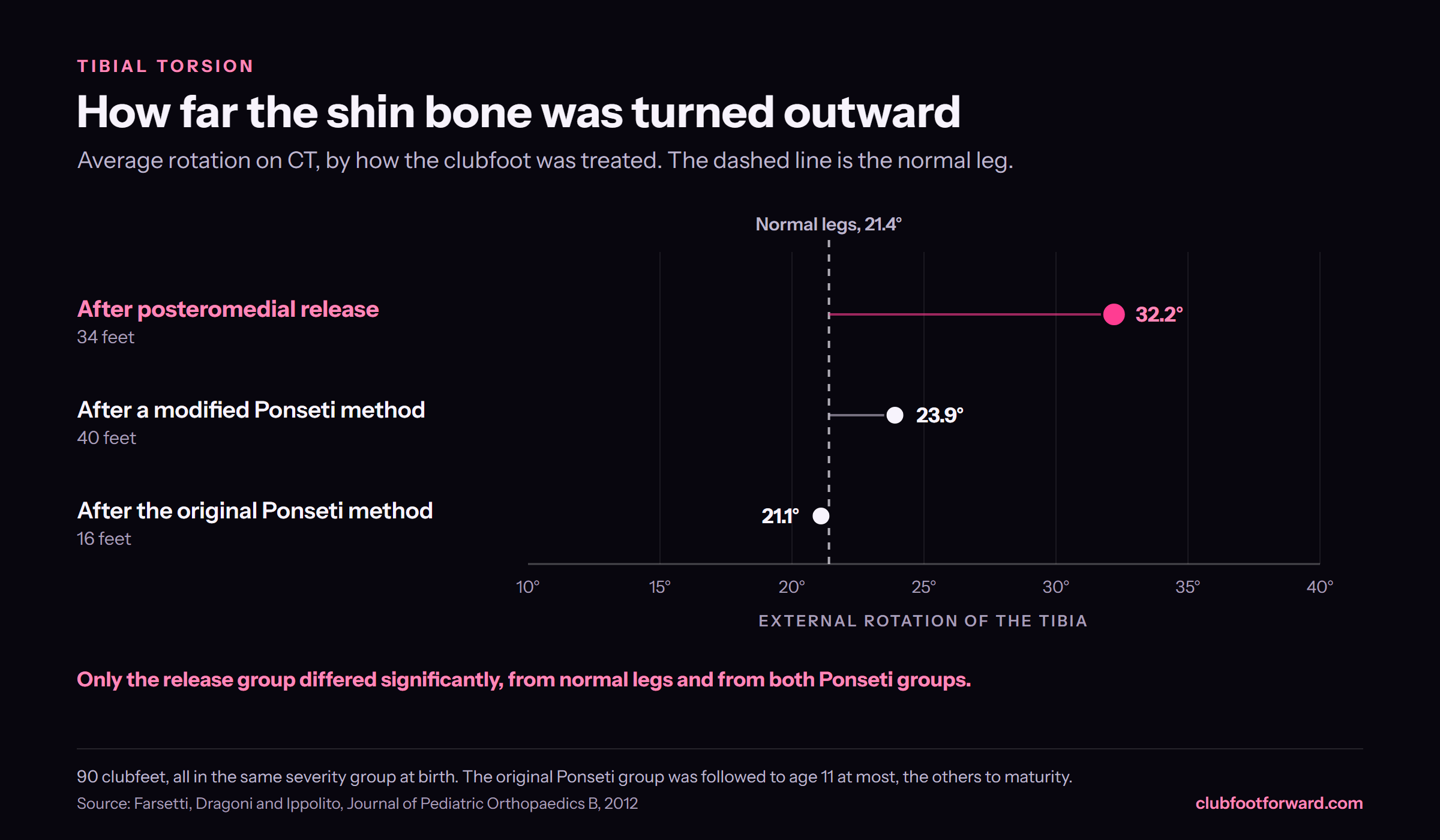
Dot chart of average external tibial rotation on CT in 90 clubfeet: 32.2 degrees after posteromedial release, 23.9 after a modified Ponseti method, 21.1 after the original Ponseti method, against 21.4 degrees in normal legs.
Normal legs are the dashed lineTwo of the three treatment groups sit almost on it. The release group is the one that does not.

People also ask

Tibial torsion in adults

Can tibial torsion be fixed in adults?
The bone itself changes only if bone is cut. A systematic review of derotational high tibial osteotomy covering 215 patients with a mean age of 27 found corrections of between about 11 and 38 degrees, patient-reported scores improving past the level considered clinically meaningful in almost every case, and satisfaction of 93.6 percent.2 That is the honest answer to whether it can be fixed. Whether it should be is a separate question, and the review written for adult surgeons says surgery should only be considered after a course of physical therapy aimed at the associated hip and gluteal weakness.1
How do you test for tibial torsion?
By hand, lying face down with the knee bent, and it works better than most people assume. The thigh-foot angle and the transmalleolar or knee-ankle axis are the two clinical measurements, and in a study of 68 limbs both correlated strongly with CT, at 0.848 and 0.889 respectively. The authors concluded that both are a reliable alternative to a scan.3 CT remains the gold standard where a number has to be exact, which in practice means when surgery is being planned.1
What are the symptoms of external tibial torsion in adults?
Usually the knee rather than the foot. Tibial torsion is a recognized cause of patellofemoral pain and instability, meaning pain at the front of the knee and a kneecap that tracks badly or gives way, and the review written for adult orthopedic surgeons says the adult version is commonly overlooked.1 A foot that turns outward more than the other, knees that seem to point inward while the feet point out, and pain going downstairs or after sitting are the things that bring people in.
Can tibial torsion be fixed without surgery?
The torsion itself, no. It is the shape of a bone, and no brace, shoe, insole or exercise reshapes a bone. What non-surgical treatment reaches is everything built on top of it, and that is not a consolation prize: the current review for adult surgeons states that surgical correction should only be considered after a course of physical therapy addressing the associated proximal and gluteal weakness.1 In other words, the strengthening comes first by design, not as a delaying tactic.
What are some good exercises for tibial torsion?
No trial has tested an exercise program against tibial torsion itself, and any list presented as doing so is somebody’s practice rather than evidence. What the adult review does specify is the target: proximal and gluteal weakness found alongside the torsion, addressed before surgery is considered.1 That points at hip abductor and external rotator strength, single-leg control, and quadriceps work for the patellofemoral joint carrying the consequence. A physical therapist who measures your rotation first is worth more than a list.
When is surgery considered for tibial torsion?
Most authors use torsion greater than 30 degrees as the main indicator for a derotation osteotomy, according to the current concept review for adult surgeons, and only after physical therapy has been tried.1 Two things in that review are worth knowing before any consultation: where the thigh bone is also rotated, correcting the tibia alone is usually enough if it is the dominant deformity, and results are worse in people who come to surgery with very high pain levels and several previous operations behind them.1
Is tibial torsion a disability?
Not as a diagnosis. Rotational variation is common, most of it never causes a symptom, and the true incidence in adults is not even known because of how much it varies between populations.1 Where it does cause limitation it does so through the knee, and any assessment would be about what the knee stops you doing rather than about a measurement in degrees.
Does clubfoot cause tibial torsion?
Some do, and in the opposite direction from the one most people expect. Measured on CT, tibiae were externally rotated an average of 32.2 degrees after posteromedial release and 23.9 and 21.1 degrees after two Ponseti protocols, against 21.4 degrees in normal legs. Only the posteromedial release group differed significantly.4 The technique used to correct the foot appeared to matter more than the clubfoot itself. Whether the in-toeing that some treated children walk with is caused by the torsion is genuinely disputed, and both sides of that are set out on this page.45

Sources

Where this comes from

Compiled by Heath, founder of Clubfoot Forward, an adult with bilateral clubfoot. This page covers tibial torsion, which travels with clubfoot but occurs on its own far more often, and is assembled from published studies rather than from personal experience. General orientation only, not an assessment of anyone’s leg and not medical advice. Rotational measurements are taken by a clinician with you on an examination couch; nothing here substitutes for that. Reviewed September 2026. See the editorial policy.