Free app · iPhone and Android

Clubfoot Forward is on the App Store and Google Play. For parents in the middle of treatment and adults who never stopped having it. Free, works with no signal, and stays on your phone.

What the app does

Yes, and here is what it costs

Plenty of adults with clubfoot (talipes equinovarus outside the United States) run, including a long way. The constraints are real and they are specific: less push-off, an asymmetric stride, and a recovery bill that arrives a day or two later. I run distance on two treated feet and a fused hindfoot, which is one data point rather than a promise.
What are you actually asking?

Twelve pages. Pick what applies and the list narrows, or ignore the chips and browse the lot.

All twelve pages

Nothing matches that combination. Clear the filters, or start with the gait cycle. Most running questions resolve into it eventually.

The three things that are actually different

Running is walking with both feet off the ground and roughly three times the force. Everything a treated clubfoot does differently at walking pace it does more of, faster, and with less margin.

Less push-offA smaller calf and a stiffer hindfoot mean less propulsion from that side, every stride.
Less shock absorptionA rigid foot cannot spread landing forces, so they travel further up the chain.
Slower recoveryThe bill arrives a day or two later, which is the number most people never think to train.

That third one is the practical difference. Almost nobody with clubfoot is stopped by the run itself. They are stopped by what the run costs afterwards, repeatedly, until they quietly give it up. Recovery is the variable worth managing.

Most people can finish the distance. Fewer can afford to do it again on Thursday.

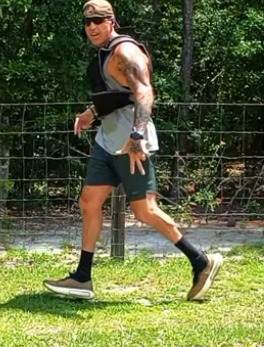
Video · 5:34Four miles in 95-degree heat in a 25-pound vest, checking in after every mile. Watch on YouTube →

Symmetry is the wrong target

Wearable metrics have made stride asymmetry visible to everyone, and it has produced a lot of unnecessary anxiety. Your stride is asymmetric because one foot has different capabilities from the other, and that asymmetry is a solution rather than a fault.

Consciously trying to even it out redistributes load toward the side that is already short of capacity. The productive targets are strength, tolerance and recovery, and if those improve, the asymmetry often reduces on its own without being aimed at.

People also ask

Running with clubfoot

Can you run with clubfoot?
Yes, and a great many adults do, including at distance. Reduced push-off power, an asymmetric stride and slower recovery are the usual constraints, and outright inability to run is not the typical outcome.
Is running bad for a clubfoot?
There is no good evidence that running damages otherwise healthy joints, and the strength and weight benefits count in your favor. An already arthritic joint has less tolerance, which changes the dose instead of ruling it out.
Will I ever run symmetrically?
Almost certainly not, and chasing symmetry is usually counterproductive. The asymmetry is a solution to a real structural constraint, and the useful targets are strength, tolerance and recovery instead.
What limits distance?
Recovery time far more often than the run itself. Most adults find they can complete the distance and then pay for it for days, which makes recovery the number worth training rather than pace.
Do I need special running shoes?
Not special, but specific. Width, some heel-to-toe drop, a firm heel counter and often a rocker matter far more than brand or price, and the right shoe changes more than most training adjustments do.
Where should I start?
If something hurts after runs, start with post-run pain. If you are building up from nothing, start with returning to running. If you are recovering from an operation, start with the surgery page instead.
What limits distance with clubfoot?
Recovery time far more often than the run itself. Most adults find they can complete the distance and then pay for it for days, which makes recovery the number worth training and not pace.

Sources

Where this comes from

Compiled by Heath, founder of Clubfoot Forward, an adult with bilateral clubfoot, childhood surgery and a triple arthrodesis, who runs distance on all of it. That is one person’s experience and not a prediction about yours. Orientation and lived experience, not medical advice or a training prescription. Reviewed September 2026. See the editorial policy.