What your casting families could hand you at the next visit
Between appointments, the record is whatever the family remembers. Brace hours get estimated at the desk, under pressure, by a parent who does not want to give the wrong answer. Clubfoot Forward is a free app that keeps that record instead, and prints it as a PDF the family brings with them. Nothing is uploaded, so there is nothing for your clinic to install, license or approve.
In one minute
What it is, and what it is not
The gap
You see the foot. You do not see the six weeks before it
Correction happens in your clinic. Everything that decides whether it holds happens somewhere else, in a house, at night, for years. The two things most likely to matter are whether the brace went on for the hours it was meant to and whether anything changed in between, and both arrive at your desk as a recollection.
Non-compliance is not a rare event either. In a cohort of 247 braced children at one hospital it ran at 33.2 percent, with heel lifting in 25.1 percent and recasting in 31.2 percent.1 Those are the families in front of you, and the conversation about it usually starts with an estimate nobody can check.
This app does not fix adherence. It gives the family somewhere to put what actually happened, so the conversation starts from a record instead of from an apology.
The record
What families log
| Stage | What the app holds |
|---|---|
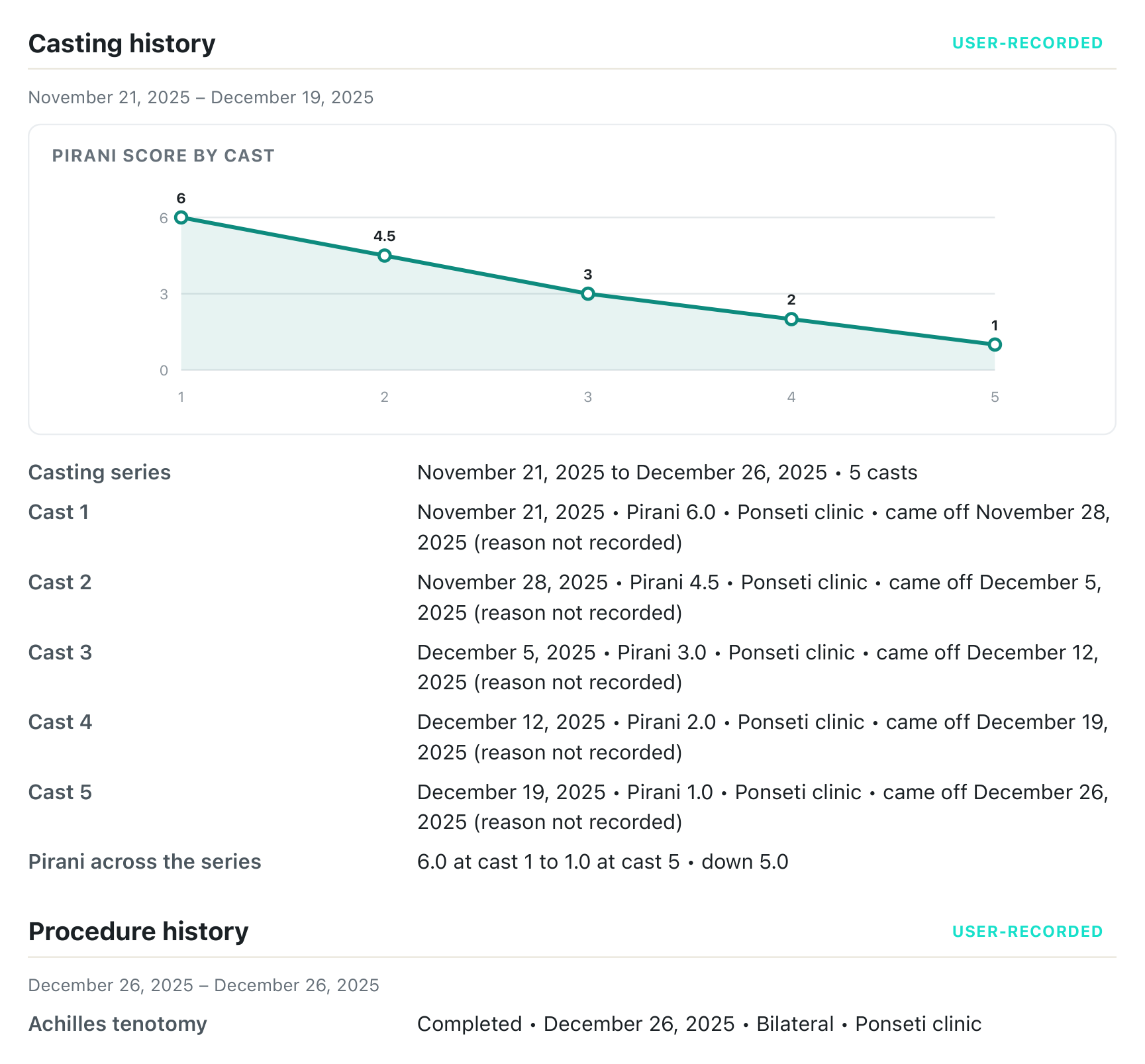
| Casting | Each cast in the series, with its Pirani and Dimeglio scores charted over time, plus a note when a cast comes off early and why |
| Tenotomy | Logged with its date, inside the same series |
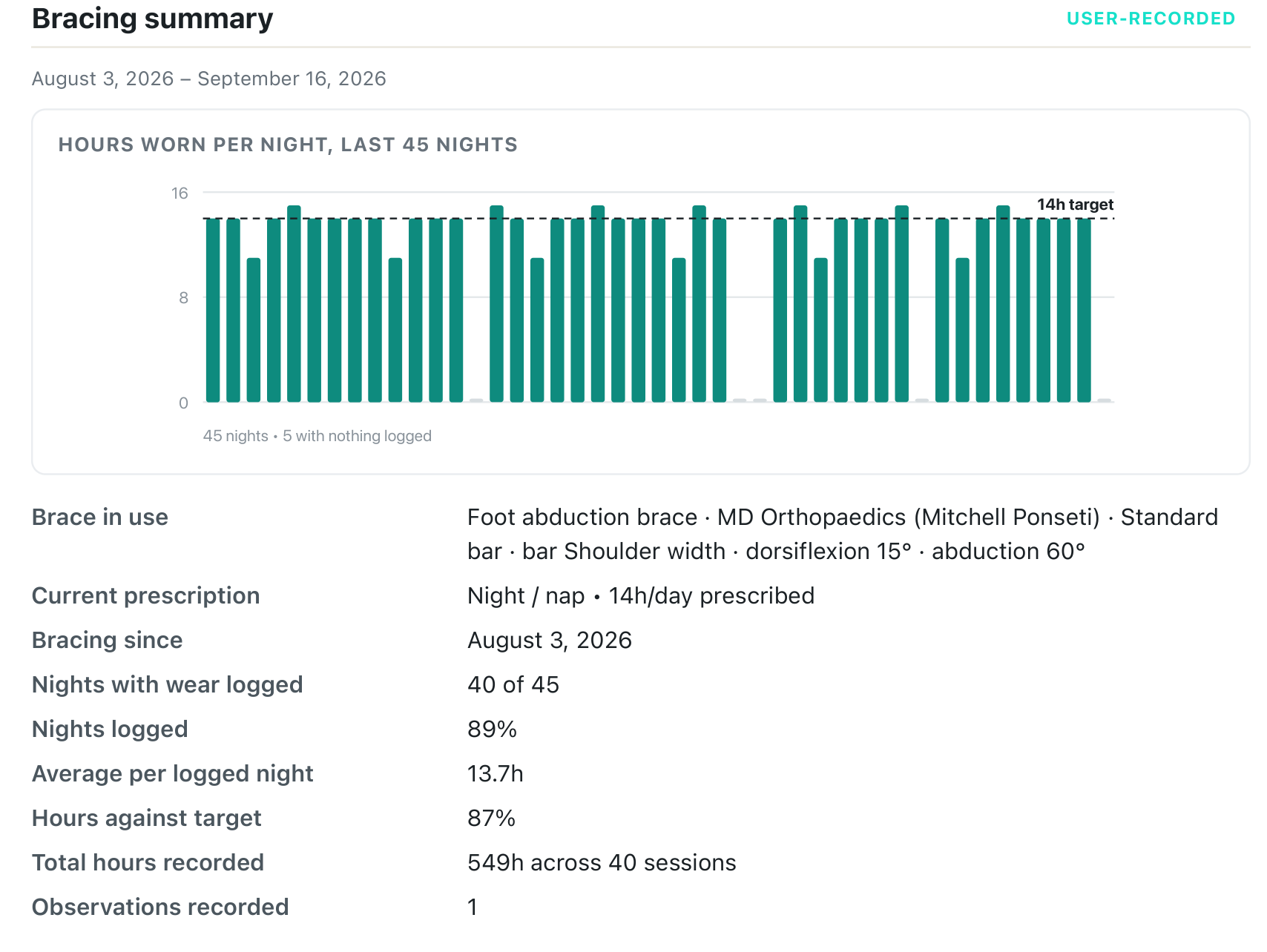
| Bracing | A one-tap wear timer, optional night and morning reminders, and a before and after comparison when the setup changes |
| Appointments | A question list built before the visit and kept open in the room, and what was said, recorded before the family gets home |
| Afterwards | The adult side: pain check-ins, function and activity, past surgeries with documents, progress photos, footwear and orthotics |
The last row is the part I care most about, for a reason that is personal. My own pediatric file closed a few weeks before I turned eighteen, and for the next twenty-three years there was nowhere for any of it to go. The patients you are casting this month will be forty-one one day, and they will want the record you are creating now.
At the visit
What you receive
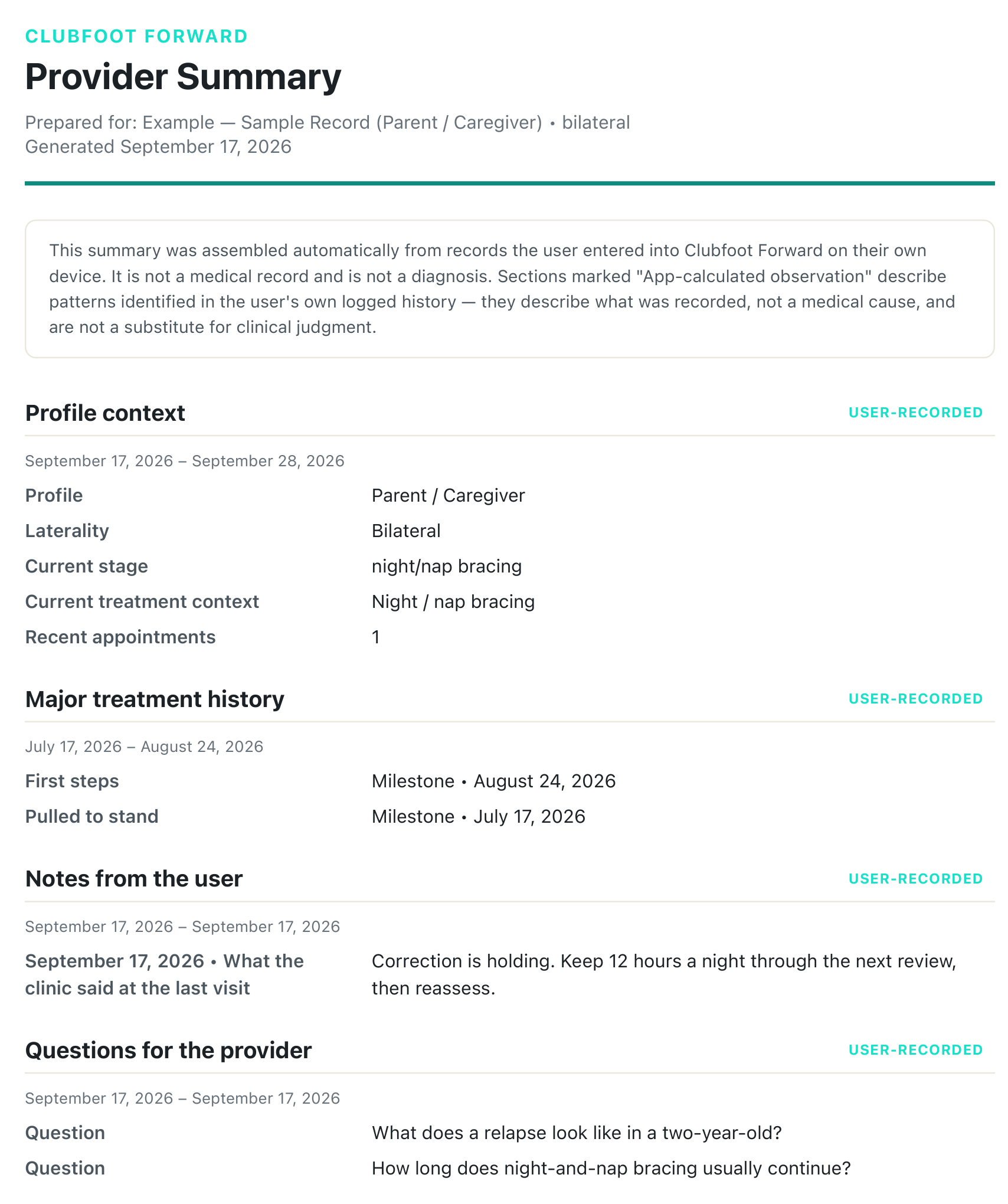
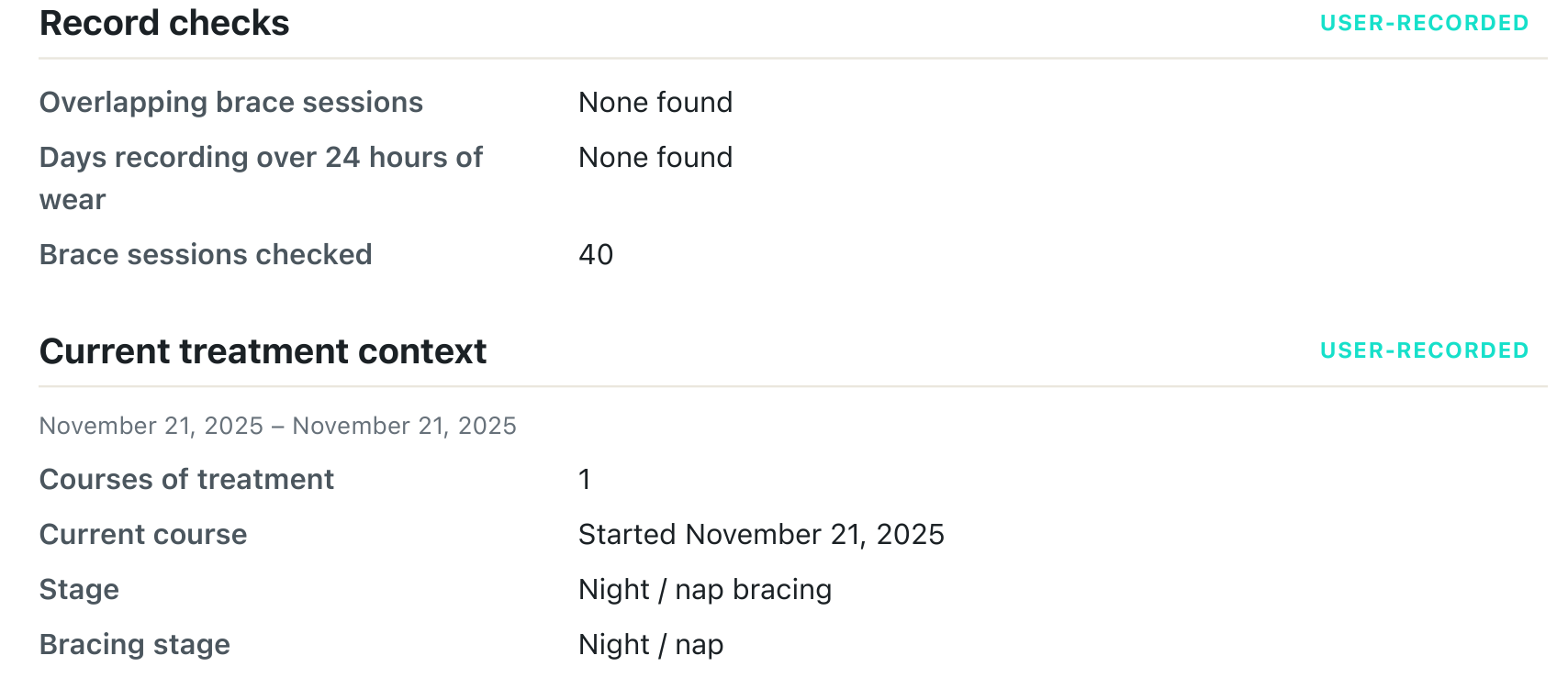
The family taps Share with Doctor and hands you a PDF. It carries the casting series with its scores, brace hours against the prescription, the brace in use, milestones, what the parent has observed, appointments and their questions. It separates what the family recorded from anything the app worked out, so a trend line is never presented to you as a finding.
It arrives the way a paper diary arrives: from the patient, in the room. There is no portal, no login, no integration and no data-sharing agreement, because nothing ever leaves their device to begin with.
The questions you will ask
Privacy, cost and what it is funded by
Where does the data live?
Does anything leave the device?
What does it cost a clinic?
Is it a medical device?
Who wrote it?
What if a family does not have a smartphone?
If you want to try it
A three-month trial, and an honest answer at the end
Here is the version I would most like to do. Offer the app to families starting casting for three months. At the end, tell me two things: whether anyone turned up with the PDF, and whether it made the visit better or worse. That is all.
If the answer is that nobody used it, I will say so publicly, because a tool that families do not use is worth knowing about and I have withdrawn my own published work before when the data did not hold. If it does help, that is the start of something worth writing up properly, with your name on it rather than mine.
I can supply printable cards with a code that opens the app on either phone, a one-page summary for your team, and a sample of the PDF so you can see the output before a single family installs anything.
Sources
Where this comes from
Written by Heath, founder of Clubfoot Forward, an adult with bilateral clubfoot, childhood surgery and a triple arthrodesis. He is not a clinician and nothing here is clinical guidance. The app is a patient-held record and is not a medical device, not a diagnostic and not a substitute for examination. Reviewed September 2026. See the editorial policy.