
Exercises after an ankle fusion
There is no tested exercise program for this operation anywhere in the published literature. What there is, and what almost nobody puts in front of you, is a set of studies that measured when people got back to exercise, what they went back to, what stayed limited, and what the fused side stops contributing. That is this page, with the numbers attached.
Start here
Why nobody can hand you a protocol
Search for exercises after an ankle fusion and you get lists. Almost none of them say where they came from, and the reason is that the research on ankle arthrodesis measures outcomes rather than testing programs. It records when people walked, when they went back to work, what they took up again, and what happened to the neighboring joints over the following decade. It does not contain a rehabilitation protocol that anyone has compared against another one.
That is not a reason to do nothing. It is a reason to be clear about which parts of this are evidence and which parts are your surgeon’s judgment about your fixation, your bone and your foot. The evidence is below. The judgment is theirs, and they are the only person who has seen the x-rays.
The one study that timed it
When other people got back to exercise
Sixty-one people with advanced ankle arthritis, all treated with an isolated ankle arthrodesis at one hospital, average age 63. The researchers recorded four time points afterwards. These are group averages with 95 percent confidence intervals, from a retrospective single-center study, which is the weakest of the designs represented on this page.1
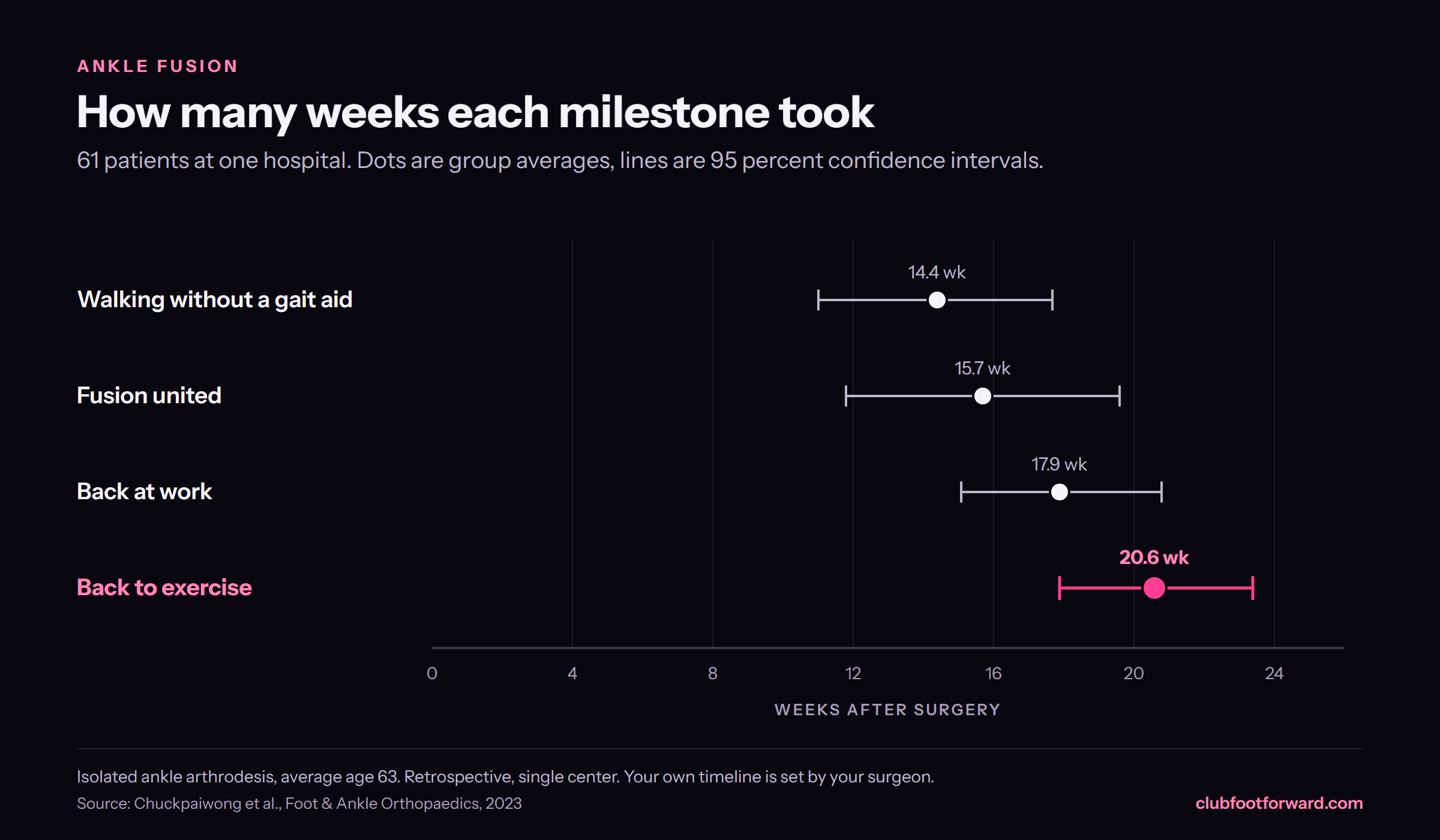
Two things are worth pulling out of that list. Exercise came last, several weeks after work, and it came after union rather than alongside it. And the spread is wide: the interval on the exercise figure runs from a little over four months to nearly six, in a group all operated on by the same service. An individual number outside that range is not a failure.
The same study measured the remaining up-and-down movement through the rest of the foot afterwards at an average of 22.7 degrees.1 That movement is not the ankle. It is the joints below and in front of it doing the job, which is the whole subject of the next section.
What changed underneath
The fused side stops pushing, and the other leg starts balancing
A Dutch group put eight people with painless, successfully fused ankles through four tasks: walking at preferred speed, walking fast, standing up from a chair, and balancing on foam. It is a small study and it says small things carefully.3
Read that as a map of where the work went, not as a training plan. The one thing it does point at is balance. If the unaffected leg is carrying the balance load, then single-leg work on both sides is a more defensible use of time than chasing strength in a calf attached to a joint that no longer moves.
Pick one
What do you want to get back to?
Swimming
Swimming is one of the four activities that came out most often in a systematic review of 1,270 ankle procedures, alongside hiking, cycling and skiing.2 It is the least demanding thing on this list for a fused ankle, because it asks for almost none of the motion that was removed.
Cycling
Also on the short list of activities people keep after these operations.2 A bike holds the foot in one position and asks the hip and knee for the power, which is close to the arrangement a fused ankle already has.
Walking and hiking
Hiking is on the same short list.2 Walking is also the function the operation is mostly performed to restore, and the timing study had people off their gait aid at an average of 14.4 weeks.1
Running and field sports
This is where the published work disagrees with itself, and you should see both halves. The systematic review found high-impact sports such as tennis, soccer and running were consistently limited after surgery.2 The single-center series found 64 percent of its patients returned to high-impact-type activity.1
A job on my feet
The timing study recorded return to work at an average of 17.9 weeks, with an interval of 15.1 to 20.8, in a group whose average age was 63.1 It did not separate desk work from standing work, which is the distinction you need, so treat that figure as a floor rather than an estimate.
The ten-year question
What a decade later looks like
The closest published answer comes from 66 ankle fusions followed for a mean of nine years. Fusion was achieved in 91 percent after the first operation, six patients needed a second procedure to get there, and 91 percent said they were satisfied with the clinical result.4
Arthritis had clearly progressed in every neighboring joint. The authors then wrote the sentence that most summaries of this study drop: the functional and clinical importance of that progression remains unclear.4 Both halves are the finding. Something is visible on the films; what it costs the person is not established.
The failure people ask about
If it does not unite
A nonunion is a fusion that did not set. It is the complication searched for more than any other, and there are two honest ways to count it, which give two different pictures.
That last figure is the uncomfortable one, and it is worth understanding rather than being alarmed by. When reviewers restricted themselves to studies that confirmed union on CT, the rate came out below the greater-than-90-percent figures reported earlier, and the authors say so directly: their stated purpose is to give surgeons better numbers for consent conversations.6 A CT sees gaps a plain x-ray does not. Some of what it finds is a fusion that is doing its job anyway.
The practical version: a nonunion usually means a second operation, roughly one in ten people in the pooled estimate, and the odds are worse for the larger fusions than for an isolated ankle.
People also ask
Exercise after an ankle fusion
What exercises are recommended after an ankle fusion?
How long after an ankle fusion can you exercise?
What exercise should you avoid after an ankle fusion?
Can you swim after an ankle fusion?
Should you do calf exercises after an ankle fusion?
How can I walk normally after an ankle fusion?
What happens 10 years after an ankle fusion?
What happens if an ankle fusion does not unite?
Is an ankle fusion the same as a triple arthrodesis?
Sources