Clubfoot Forward Theory Study | N=1 Altered-Mechanics Archive
Study 000K: Multi-Mode Adaptive Envelope
Study 000K tests whether outside-running success in this N=1 altered-mechanics archive is better explained by one successful envelope that shifts over time, or by multiple successful low-burden envelope modes.
The study uses adult bilateral clubfoot (club foot) and documented altered biomechanics as the case context, but the broader scientific frame is adaptation under structural constraint, outside running burden, successful expression, adaptive envelopes, and multiple pathways to functional performance.
The primary answer is yes, multiple candidate modes are supported. The archive is better explained by at least two successful low-burden outside-running modes than by one single success route that only becomes stronger or weaker across phases.
Theory Study: Multiple Successful Modes, Adaptive Envelopes, and Low-Burden Expression
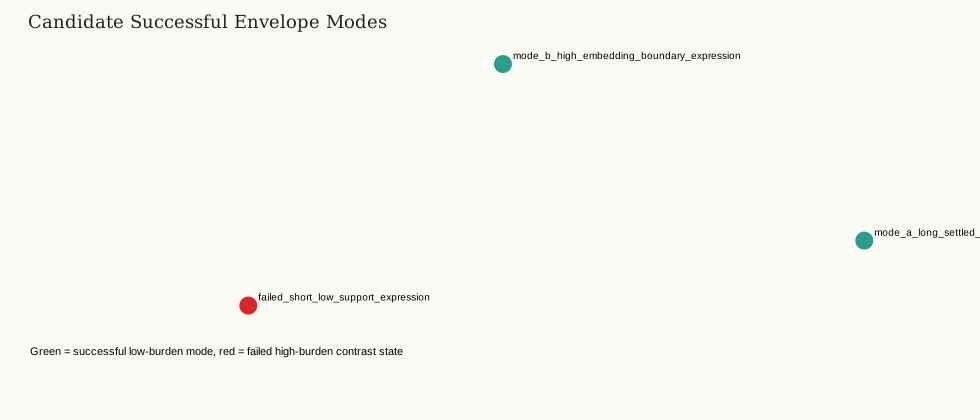
Mode A
A long-settled, low-embedding outside expression succeeded with modest surrounding support but a long, settled bout structure.
Mode B
A high-embedding boundary expression succeeded with dense surrounding treadmill support, high recent running share, and low residual burden.
Failed Contrast
A short, low-support outside state remained high burden, helping separate successful modes from unsupported outside probes.
Plain-Language Finding
The stronger answer is that the archive shows more than one successful mode.
One outside run stayed low burden because it was a long settled expression even though embedding support was only modest. Another outside run stayed low burden because it was surrounded by dense support, even though the bout was shorter.
Those look like different successful routes, not just one route becoming stronger or weaker.
Core Question
What Was Study 000K Trying to Answer?
Study 000K asks whether successful outside running should be understood as one envelope becoming stronger or weaker, or whether the archive shows more than one successful low-burden route.
The central question was: are there multiple successful envelope modes instead of one envelope that simply shifts across state and phase?
This matters because earlier studies had already shown that context mattered. Study 000J refined that idea by showing that embedding support and bout structure did not behave like one simple global hierarchy. Study 000K moves the question one level higher: maybe the system is not searching for one ideal mode at all.
Research Disclosure
Study Information and Transparency Statement
Study 000K was independently designed, conducted, analyzed, and published by Heath, founder of Clubfoot Forward. The study uses the researcher’s own longitudinal wearable-derived activity archive and derived outside boundary-expression outputs as the primary dataset.
No university, hospital, research institution, grant funding source, commercial sponsor, or outside organization participated in the design, analysis, interpretation, or publication of this work.
Researcher Information
- Researcher: Heath
- Organization: Clubfoot Forward
- Role: Founder, independent researcher, and dataset owner
- Case context: Adult with documented altered lower-limb biomechanics
Study Design
- Study type: Patient-led N=1 theory study
- Sample size: n = 1
- Primary frame: Adaptation under structural constraint
- Dataset: Boundary-expression and state-case outputs from prior studies
- Status: Completed
Funding and Oversight
- Funding: None
- Institutional affiliation: None
- Commercial sponsorship: None
- External oversight: None
- Peer reviewed: No
Major Findings
What Did Study 000K Find?
Multiple Modes Were Supported
The archive was better explained by at least two candidate successful low-burden envelope modes than by one single success route that only changed strength.
Mode A Was Long-Settled
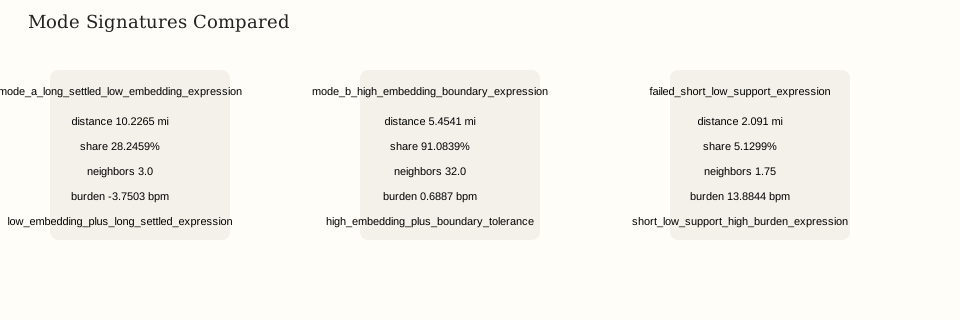
The 2025-04-16 outside expression covered 10.2265 miles, had only 28.2459% running-share context, only 3 treadmill neighbors, and still produced -3.7503 bpm HR residual burden.
Mode B Was High-Embedding
The 2026-04-09 boundary expression covered 5.4541 miles, had 91.0839% running-share context, 32 treadmill neighbors, and only +0.6887 bpm HR residual burden.
The Failed Contrast Was Short and Unsupported
The October 2025 cluster averaged 2.091 miles, had only 5.1299% running-share context, 1.75 treadmill neighbors, and carried +13.8844 bpm HR residual burden.
Success Was Not One Shape
Low-burden expression appeared under different support signatures. One successful route leaned on long settled bout structure; another leaned on dense embedding support.
The Theory Moved Forward
Study 000K strengthens the adaptive-envelope model by suggesting that successful expression can occur through multiple protective pathways and not one ideal condition.
Primary Interpretation
The Best-Supported Model: Multi-Mode Adaptive Envelope
Study 000K shifts the support branch from a single-route model to a multi-mode model.
The archive does not simply show that one support mechanism grew stronger over time. It shows at least two distinct low-burden outside expressions with different support signatures.
One route tolerated low embedding through a very long settled bout. Another route tolerated outside-surface expression through dense embedding support. The failed contrast state was short, weakly embedded, and high burden.
The strongest interpretation is: adaptation under constraint may produce multiple successful envelope modes instead of one universal success route.
Mode Comparison
How The Candidate Modes Compared
Mode A: Long-Settled Low-Embedding
- Anchor: 2025-04-16
- Distance: 10.2265 miles
- Running-share context: 28.2459%
- Treadmill neighbors: 3.0
- HR residual burden: -3.7503 bpm
This mode suggests that a long settled bout can preserve low-burden expression even when local embedding support is only modest.
Mode B: High-Embedding Boundary
- Anchor: 2026-04-09
- Distance: 5.4541 miles
- Running-share context: 91.0839%
- Treadmill neighbors: 32.0
- HR residual burden: +0.6887 bpm
This mode suggests that dense embedding support can also preserve low-burden outside expression, even without the same long-bout structure as Mode A.
Failed Contrast: Short Low-Support
- Anchor: 2025-10 cluster mean
- Distance: 2.091 miles
- Running-share context: 5.1299%
- Treadmill neighbors: 1.75
- HR residual burden: +13.8844 bpm
The failed contrast state helps define what the successful modes are not: short, weakly embedded, and high burden.
Why This Matters
Why Study 000K Changes The Larger Theory
A single-route model would suggest that the system has one best way to succeed, and that later adaptation simply makes that route stronger.
Study 000K supports something more interesting. A structurally constrained system may develop more than one successful mode. One mode may rely on settled bout structure. Another may rely on dense embedding. Both may produce low-burden expression, but through different support signatures.
This matters for the later integration study because it supports the idea that adaptation under constraint is not merely normalization. It may be a process of building multiple usable expression modes inside the limits of a non-normal mechanical system.
Study Context
How Study 000K Fits The Research Tree
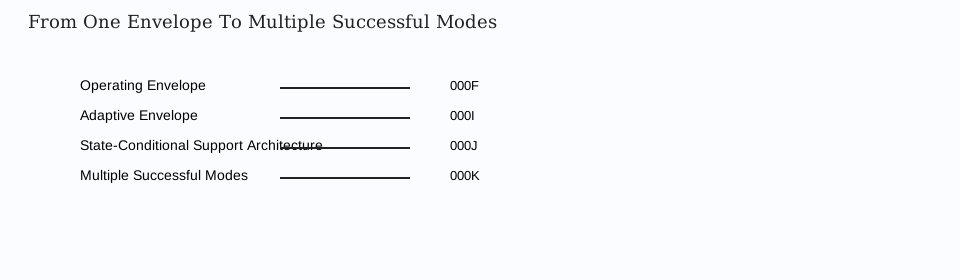
Study 000K builds directly from Studies 000F, 000I, and 000J. It depends on the operating-envelope, adaptive-envelope, and embedding-versus-bout findings developed in earlier branches.
Study 000F
Study 000F established that successful expression depended on operating-envelope conditions and not surface category alone.
Read Study 000FStudy 000J
Study 000J showed that embedding support and bout structure did not collapse into one simple global hierarchy.
Read Study 000JAll Studies
Browse the full study archive and see how Study 000K fits into the broader research tree.
View All StudiesRead the Study
Study 000K Files
These files are hosted directly inside the public Study 000K folder. Start with the plain-language summary, then review the manuscript, methods, results, discussion, audit, outputs, and source tables.
Full Study Sections
Figures
Study Figures and Visual Outputs
These figures summarize the mode space, candidate mode signatures, and theory progression from one envelope to multiple successful modes.
Downloads, Source Tables, and Derived Outputs
The files below are provided for transparency, inspection, and review. Source tables represent packaged input data. Derived outputs are processed summaries generated during the Study 000K analysis.
Source Tables
- Study 000F Boundary Expression Table
- Study 000I State Case Table
- Study 000J Factor Comparison Matrix
- Study 000J Subgroup Summary
Derived Outputs
How to Read This Study
What Study 000K Can and Cannot Show
It Can Identify Candidate Modes
Study 000K can show that the current archive contains at least two low-burden outside expressions with meaningfully different support signatures.
It Cannot Map Every Possible Mode
The study cannot prove that all successful envelope modes have been discovered, or that future data will not reveal additional modes.
It Raises Integration Questions
Study 000K raises later questions about mode switching, support hierarchy, burden transfer, and whether adaptive envelopes expand by adding usable modes instead of becoming globally normal.
Keyword Coverage
Topics This Study Covers
Study 000K supports the broader research cluster around altered biomechanics, adaptive envelopes, successful expression, outside running burden, and adaptation under structural constraint.
Adaptive Envelope Queries
- multi-mode adaptive envelope
- adaptive envelope running
- successful operating envelope
- low-burden running expression
Altered Mechanics Queries
- adaptation under structural constraint
- altered biomechanics running
- clubfoot running adaptation
- non-normal mechanics functional success
Wearable Data Queries
- N=1 wearable data study
- outside running burden
- HR residual burden
- patient-led research archive
Related Research
How Study 000K Connects to the Research Archive
Research Hub
Return to the full Clubfoot Forward research archive for all flagship studies, mechanism studies, and microstudies.
Return to Research HubStudy 000J
Companion mechanism study comparing embedding support against bout structure in outside expression.
Read Study 000JAll Studies
Browse the full study archive and see how Study 000K fits into the broader research tree.
View All StudiesTopical Authority
Related Clubfoot Forward Pages
Gait & Compensation Hub
Explains compensation, altered gait, fatigue, cadence, stride, and daily-life impact across altered mechanics.
Read the Gait & Compensation HubRunning With Altered Mechanics
Explains how altered mechanics affect cadence, stride, compensation, surfaces, pain, and running adaptation.
Read Running With Altered MechanicsAdult Clubfoot Hub
Broader adult hub for pain, stamina, footwear, running, military service, work, and long-term function.
Read the Adult Clubfoot HubCommon Questions About Study 000K
What is Study 000K about?
Study 000K asks whether successful outside running is better explained by one envelope that shifts over time, or by multiple successful low-burden envelope modes.
What is a multi-mode adaptive envelope?
A multi-mode adaptive envelope means the system may have more than one successful expression pattern. Different combinations of bout length, embedding support, and operating state may produce low-burden outcomes.
What was the main finding?
The main finding is that at least two candidate successful low-burden modes were supported: one long-settled low-embedding mode and one high-embedding boundary mode.
Does Study 000K prove all successful modes?
No. It identifies candidate modes in the current archive. Future data may reveal additional modes, modify the current model, or weaken parts of it.
Does Study 000K prove a medical cause?
No. It does not claim that clubfoot, fusion, anatomy, or any specific diagnosis caused a Garmin metric pattern. It describes adaptive-envelope behavior inside one documented archive.
Can these findings apply to every runner?
No. This is a single-subject study. It may raise useful questions about adaptation under constraint, but it should not be generalized without larger samples, comparison groups, and independent review.
Critical Disclaimer
Study 000K is for education, transparency, and discussion only. It is not medical advice, diagnosis, treatment guidance, clinical gait analysis, peer-reviewed medical research, or population-level biomechanics proof.
The study is a patient-led observational analysis based on available wearable-derived data and prior boundary-expression outputs. Findings should not be generalized to all adults with altered biomechanics, clubfoot, gait compensation, or outside running burden without larger studies, clinical evaluation, matched comparison groups, and independent review.