
Clubfoot Forward Flagship Study
Study 000B: Adaptive Efficiency and Internal Cost
Study 000B is a flagship companion study following Study 000A. It examines whether later running specialization in an altered-biomechanics system reflected adaptive efficiency, persistent internal burden, or both.
The current case context is adult bilateral clubfoot (talipes equinovarus), but the broader research frame is larger: altered biomechanics, adaptation under constraint, internal cost, gait compensation, running efficiency, residual heart-rate burden, recovery context, and long-term functional adaptation.
The core finding is mixed and important: later specialization coincided with improved speed-per-heart-rate efficiency and more favorable background recovery markers, but unexplained session-level heart-rate burden did not disappear.
Flagship Study: Efficiency Improved, Burden Persisted
Adaptive Efficiency
The study examines whether output improved relative to internal cost, including speed-per-heart-rate and power-per-heart-rate efficiency across early and late running windows.
Internal Cost
Study 000B does not assume improvement means burden disappeared. It specifically evaluates whether residual heart-rate burden remained after simple speed-plus-power adjustment.
Altered Biomechanics Context
Adult bilateral clubfoot is the case context. The broader question is how a mechanically altered system can become more efficient while still carrying measurable internal cost.
Relationship to Study 000A
Why Study 000B Exists
Study 000A examined whether long-term adaptation occurred. Study 000B asks a different flagship-level question: what happened to internal cost as that adaptation and specialization developed?
This distinction matters because performance improvement alone can be misleading. A mechanically altered runner may become faster, more consistent, or more specialized without becoming cost-free. Study 000B was built to examine that tension directly.
In plain language, Study 000B helps prevent an oversimplified interpretation of adaptation. The system did not simply become normal, and it did not simply become more strained. The later system appears more efficient in some ways while still preserving unexplained session-level burden.
Research Disclosure
Study Information and Transparency Statement
Study 000B was independently designed, conducted, analyzed, and published by Heath, founder of Clubfoot Forward. The study uses the researcher’s own longitudinal activity, running, and adaptation data as the primary dataset.
No university, hospital, research institution, grant funding source, commercial sponsor, or outside organization participated in the design, analysis, interpretation, or publication of this work.
This study is not presented as population-level clinical proof. It is a transparent patient-led observational analysis using one adult’s long-term altered-biomechanics dataset to examine adaptive efficiency, persistent internal cost, recovery context, and future research questions.
Researcher Information
- Researcher: Heath
- Organization: Clubfoot Forward
- Role: Founder, independent researcher, and dataset owner
- Case context: Adult with bilateral congenital clubfoot
Study Design
- Study type: Flagship patient-led observational study
- Sample size: n = 1
- Primary frame: Adaptive efficiency and internal cost
- Dataset: Longitudinal running and activity data
- Status: Completed
Funding and Oversight
- Funding: None
- Institutional affiliation: None
- Commercial sponsorship: None
- External oversight: None
- Peer reviewed: No
Main Finding in Plain Language
Study 000B found that later specialization looked more efficient, but not free of cost. Speed-per-heart-rate efficiency improved by 13.41%, while power-per-heart-rate efficiency improved by 2.82%. At the same time, the descriptive heart-rate residual model showed a 4.69 bpm upward shift in unexplained burden.
That means the later system was not reducible to either pure efficiency gain or pure hidden cost. It showed both: better output efficiency and persistent internal burden.
Study Summary
What Study 000B Examines
What Was Studied?
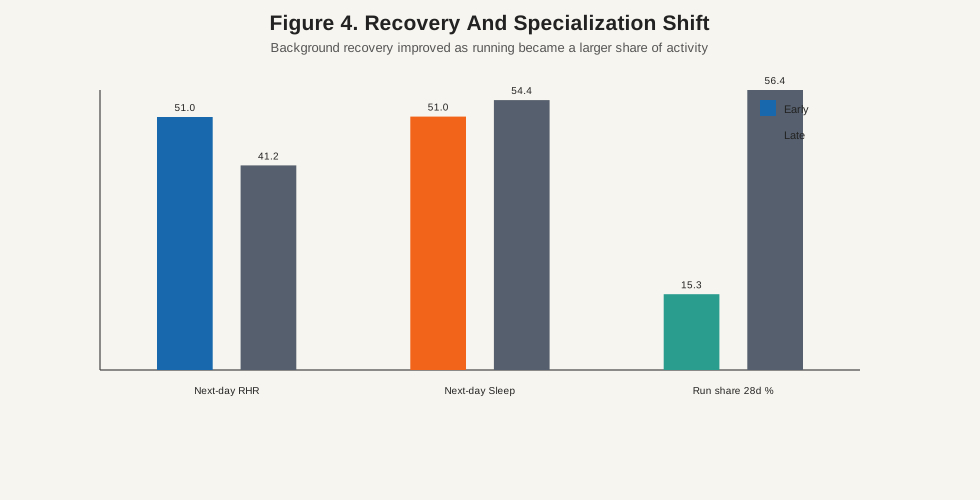
Study 000B compared early and late QC-pass running windows to examine efficiency, heart-rate burden, running specialization, and next-day recovery context.
What Was Found?
Running specialization increased sharply, speed-per-heart-rate efficiency improved, recovery markers moved in a favorable direction, but unexplained session heart-rate burden still shifted upward.
Why It Matters
The study shows that adaptation under constraint may improve efficiency without eliminating internal cost. Function can improve while burden remains measurable.
Key Result
Efficiency Improved Without Becoming Cost-Free
The strongest finding is the mixed pattern. Speed increased by 36.11%, average heart rate increased by 21.03%, and speed-per-heart-rate efficiency improved by 13.41%. That supports adaptive efficiency.
But the same late window also showed a positive residual heart-rate burden after simple speed-plus-power adjustment. Mean residual burden shifted from -1.60 bpm in the early window to 3.09 bpm in the late window.
This is why Study 000B matters as a flagship study. It does not simply repeat that adaptation occurred. It asks what adaptation cost internally.
Study Files
Read Study 000B
These files are hosted directly from the public Study 000B archive. Start with the abstract or plain-language summary, then review the manuscript, methods, results, discussion, and limitations.
Quick Read
Full Study Sections
Audit and Replicatio
Figures
Study Figures and Visual Outputs
These figures summarize output-cost change, monthly specialization and efficiency, residual heart-rate burden, and recovery shift.


Downloads, Source Tables, and Derived Outputs
The files below are provided for transparency, inspection, and review. Source tables represent packaged input data. Derived outputs are processed summaries generated during the Study 000B analysis.
Source Tables
- Food and Garmin Overlap Source Table
- Conserved Mechanics Runs Source Table
- Total Fitness Profile Timeline Source Table
Derived Outputs
Research Principles
How Study 000B Should Be Interpreted
Mixed Signal, Not Simple Victory
The study supports both improved efficiency and persistent burden. It should not be reduced to “everything improved” or “nothing improved.”
Descriptive, Not Causal
The heart-rate residual model is intentionally simple and descriptive. It can identify patterns, but it cannot prove causal physiological mechanisms.
Run-Count Matched
Early and late windows are matched by QC-pass run count, not elapsed calendar time. That matters when interpreting specialization density.
Future Research
What Study 000B Cannot Answer Alone
Study 000B raises useful questions about adaptive efficiency, internal cost, specialization, and recovery, but it cannot answer population-level biomechanics or medical questions by itself.
- Do other adults with altered biomechanics show improved output efficiency while preserving internal burden?
- Does residual heart-rate burden reflect mechanical cost, cardiovascular strain, terrain, fatigue, or other variables?
- How do clinical gait-lab metrics compare with wearable-derived efficiency and residual-burden patterns?
- Can adaptive efficiency improve while pain, fatigue, or recovery burden remain clinically meaningful?
- How do surface stabilization and cadence-stride behavior interact with internal cost?
Related Research
How Study 000B Connects to the Research Archive
Research Hub
Return to the full Clubfoot Forward research archive for all flagship studies and microstudies.
Return to Research HubStudy 000A
The flagship longitudinal adaptation synthesis that established the broader adaptation framework.
Read Study 000AMicrostudy A
Supporting microstudy examining surface stabilization and lower stabilization-demand environments.
Read Microstudy ACommon Questions About Study 000B
Is Study 000B a microstudy?
No. Study 000B is a flagship companion study. It asks a separate primary question from Study 000A: what happened to internal cost as adaptation and running specialization developed?
Does Study 000B prove adaptation eliminated burden?
No. The study found improved efficiency, but also persistent unexplained session-level heart-rate burden. The later system looked more efficient, not cost-free.
Is this only about clubfoot?
No. Adult bilateral clubfoot is the current case context, but the broader frame is altered biomechanics, adaptive efficiency, internal cost, gait compensation, and long-term function.
Can this apply to every adult with altered biomechanics?
No. This is a single-subject patient-led analysis. It may raise useful research questions, but it should not be generalized without larger samples, clinical evaluation, and independent review.
Why does this study matter?
It shows that adaptation can be both real and costly. A person can become more efficient while still carrying measurable internal burden.
Critical Disclaimer
Study 000B is for education, transparency, and discussion only. It is not medical advice, diagnosis, treatment guidance, clinical gait analysis, peer-reviewed medical research, or population-level biomechanics proof.
The study is a patient-led observational analysis based on available data and lived experience. Findings should not be generalized to all adults with altered biomechanics, clubfoot, gait compensation, or congenital lower-limb conditions without larger studies, clinical evaluation, matched comparison groups, and independent review.