
Running on a fused hindfoot
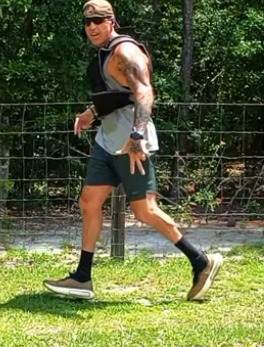
I have a triple arthrodesis and I run distance on it. That is one data point rather than a promise, but it is a more useful starting point than the assumption most people arrive with, which is that fusion ends running.
Five things that change. Open whichever matter to you. The first two are permanent, the last three adapt.
The ground stops being negotiable The single largest change, and the one nobody warns you about. Permanent2 min
A normal hindfoot tilts to meet whatever is under it. A fused one does not, so instead of the foot adapting to the ground, your whole leg does. And everything above the fusion takes the correction.
On a road this barely registers. On a rutted trail, a cambered lane or a beach it registers constantly, and it is tiring in a way that has nothing to do with fitness.
Almost all of my own running over the last year has been on a treadmill. That is not a loss of capability so much as a rational choice about where the surface fights you.
The motion is gone, and stretching will not find it Worth stating plainly, because people spend months looking for it. Permanent2 min
Fusion means the bones have grown together. There is no joint there any more, so no amount of mobility work, manipulation or persistence will produce movement at that site, and any program that implies otherwise is wrong.
This is genuinely liberating once accepted. It removes a whole category of effort that was never going to pay, and redirects it toward the things that do: the ankle above, the calf, the hip, and the shoe.
Ask your surgeon exactly which joints were fused and which were left. “Triple” means three specific hindfoot joints; other fusions involve different ones, and what remains mobile is what you are working with.
The timeline is bone, not tissue Longer than soft-tissue surgery, for a reason worth understanding. Adapts2 min
A fusion has to unite. Until the bones have actually grown together, impact is not just uncomfortable but genuinely inadvisable, and your surgeon confirms union before running enters the conversation.
Nine to twelve months to running is a realistic expectation, and considerably longer than people hope when they ask at the six-week appointment. Walking comes much earlier; running waits for the X-ray.
| Roughly | Usually |
|---|---|
| First months | Protected, non- or partial weight-bearing |
| Around 3 months | Union assessed, walking building |
| 3 to 6 months | Strength, and a great deal of walking |
| 6 to 9 months | Impact reintroduced gradually |
| 9 to 12 months | Running, if union is solid |
Broad ranges from general practice, not your plan. The surgery recovery page covers the phases in more detail, and your surgeon’s protocol beats both.
The shoe does more of the work now Footwear stops being a preference and becomes equipment. Adapts2 min
With the hindfoot fused, the roll through the step has to come from somewhere, and the somewhere is the sole of the shoe. A rocker profile stops being a nice feature and starts being the mechanism by which your stride works.
A wide, stable platform matters more too, because the foot can no longer make small corrections underneath you. Minimalist shoes, which ask the foot to do exactly what a fused foot cannot, are the clearest thing to avoid.
Now matters more
- A pronounced rocker
- A wide, stable sole platform
- Cushioning, since the foot absorbs less
- A firm heel counter
- Buying two pairs of whatever works
Now matters less, or hurts
- Minimalist or zero-drop shoes
- Anything marketed on foot strength
- Narrow racing profiles
- Motion-control designs for a foot that cannot move
The neighboring joints, honestly The real long-term consideration, and it is not a reason to stop running. Long term2 min
Fusing a joint transfers demand to the joints beside it. Adjacent joint change over the following years is documented and is a genuine consideration, and it is one reason fusion is offered for pain relief, not as an upgrade.
What that does not mean is that running is the thing accelerating it. Walking, standing and daily life load those joints too, and the evidence that running damages otherwise healthy joints is weak. Being sedentary carries its own well-documented costs.
The honest position: this is worth discussing with your own surgeon, who knows what was fused and what state the neighbors are in. It is a conversation, not a prohibition, and it deserves better than either reassurance or alarm from a web page.
What it is actually like
The thing nobody told me is how much of the change is about surface and not about capacity. I can run a long way. I cannot enjoy running on a rutted trail, and no amount of training will change that, because the joint that used to handle rutted trails is not there.
The second thing is that it hurt less afterwards, which is the entire point and is easy to lose sight of in a conversation about what was traded away. Fusion buys pain relief with movement. When the pain was the thing limiting your running, that trade can go decidedly in your favor.
Fusion did not end running for me. It changed which running was worth doing.
None of that predicts your outcome. Fusions differ, the joints involved differ, the state of the rest of your foot differs, and plenty of people with a hindfoot fusion do not run and are entirely well. One person’s experience is a data point and never a forecast.
People also ask
Running after fusion
Can you run after a triple arthrodesis?
Does it hurt to run on a fused hindfoot?
What surfaces are hardest?
Do I need special shoes?
Will running damage the fusion?
What does a fusion actually change for running?
How long before running after a fusion?
Will the neighboring joints wear out faster?
Do I need special shoes afterwards?
Is running going to damage the fusion?
Sources