Altered Mechanics Flagship Mechanism Study
Study 000H: Envelope Support Factors
Home / Research / All Studies / Study 000H
Study 000H asks which support factors help convert cadence-protected outside-surface running from high-burden expression into low-burden expression inside an altered-mechanics operating envelope.
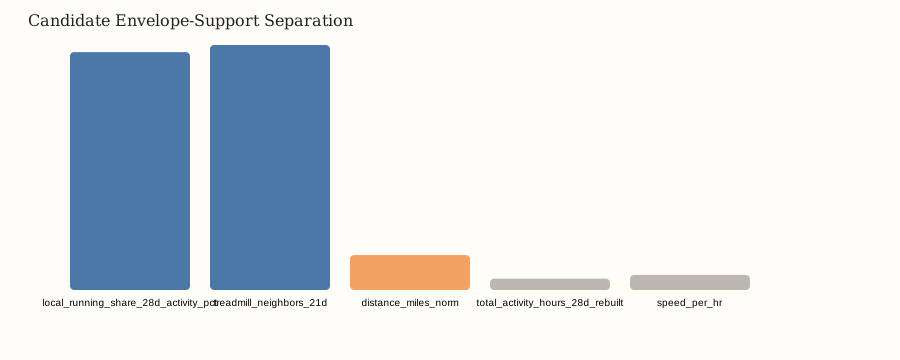
The strongest supported answer is high local running embedding and dense stabilized-context continuity. Longer bout structure appears to be a plausible secondary factor, but the current data separates embedding support more cleanly than bout length.
Study 000H: Local Ecology Appears to Carry Envelope Support
Core Question
Which envelope-support factors explain why cadence-protected outside-surface running can be high burden in one context and low burden in another?
Core Answer
High local running embedding and dense stabilized-context continuity were the strongest supported separators between high-burden and low-burden expression.
Why It Matters
Study 000H shows that cadence protection is real but incomplete. The system also appears to need local ecological support to keep burden low.
Study Purpose
Why Study 000H Was Needed
Study 000G showed that cadence behaves like the more preservable control variable while stride behaves like the more sacrificial expression variable. But it also showed that cadence protection alone does not guarantee low internal burden.
Study 000H asks the next mechanism question: when cadence protection is present, what else determines whether outside-surface running becomes high burden or remains low burden?
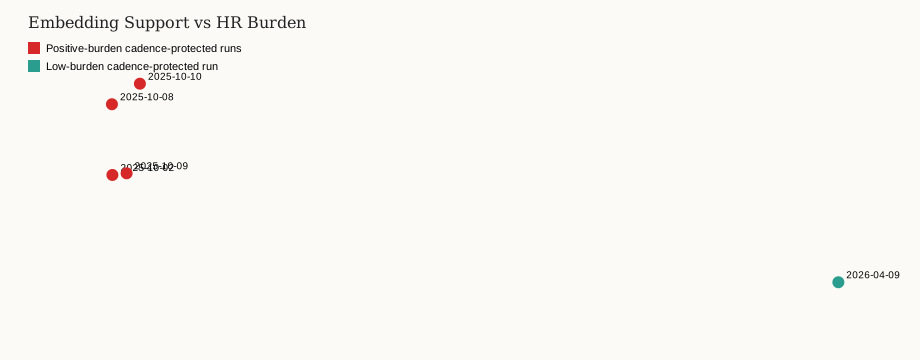
The study compares the October 2025 high-burden outside-context cluster against the April 2026 low-burden boundary probe to identify which support factors separated the two outcomes.
Plain-Language Finding
The same protected mechanical pattern did not always produce the same burden outcome.
Cadence protection was present in both the high-burden and low-burden cases. The strongest difference was the local support around the run: recent running density and stabilized-context continuity were much higher in the low-burden case.
In plain language: the system appeared to carry support from its local training ecology.
Primary Contrast
The High-Burden Cluster vs the Low-Burden Boundary Probe
October 2025 Cluster
Cadence-protected but high-burden outside-context cluster.
- Running-share context: 5.13%
- Treadmill neighbors: 1.75
- Mean burden: 13.88 bpm
April 2026 Boundary Probe
Cadence-protected but low-burden outside-surface boundary probe.
- Running-share context: 91.08%
- Treadmill neighbors: 32
- Burden: 0.69 bpm
Interpretation
Cadence protection was not enough by itself. The low-burden case was embedded in a much denser local running and stabilized-context support structure.
Main Finding
Embedding Support Was the Strongest Separator
The clearest support factor was local running embedding. The low-burden April 2026 probe occurred with 91.08% running-share context, while the high-burden October 2025 cluster occurred with only 5.13% running-share context.
Stabilized-context continuity showed the same direction. The April 2026 probe had 32 treadmill neighbors, while the October cluster averaged only 1.75.
This suggests that the operating envelope was not supported by cadence alone. It was also supported by the local ecology around the run.
Secondary Factor
Bout Length Looks Plausible but Less Isolated
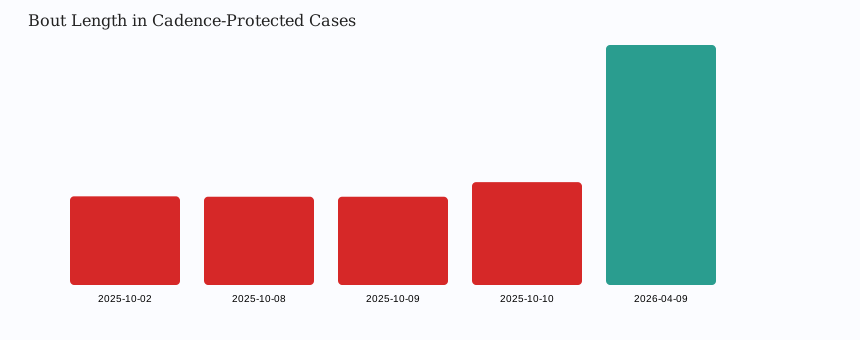
Longer bout structure appears to be a real secondary candidate. Earlier long outdoor expression and the April 2026 boundary probe suggest that longer, more settled expressions may behave differently than short outside-surface probes.
However, the current data does not isolate bout length as cleanly as embedding support. The stronger separator in the current comparison is local running embedding and stabilized-context continuity.
That creates the next child question: when embedding support and bout length diverge, which factor carries more weight in preserving low-burden expression?
Study 000H’s Main Conclusio
The strongest supported conclusion is:
High local running embedding and dense stabilized-context continuity were the strongest supported envelope-support factors separating cadence-protected high-burden expression from cadence-protected low-burden expression.
Program Meaning
Why Study 000H Changes the Model
Study 000H moves the archive beyond a simple mechanics-only explanation. Cadence protection matters, but it is not sufficient by itself.
The supported model now looks more like this: local ecology supports the operating envelope, the operating envelope supports low-burden expression, and cadence protection helps preserve running mechanics inside that supported state.
This makes the altered-mechanics program more transferable. Many movement systems shaped by joint limitation, surgery history, chronic stiffness, asymmetry, fusion, arthritis, or long-term compensation may depend on local ecological support instead of isolated mechanics alone.
New Question Created
What Study 000H Opens Next
Study 000H answers Q023, but it creates a cleaner refinement question:
When embedding support and bout length diverge, which factor carries more weight in preserving low-burden expression?
That question is important, but the next larger theory move is Study 000I: Adaptive Envelope Theory, which asks whether the successful operating envelope itself shifts across training state and phase.
Research Disclosure
Study Information and Transparency Statement
Study 000H was independently designed, conducted, analyzed, and published by Heath, founder of Clubfoot Forward. It uses the researcher’s own longitudinal activity and running data, along with packaged outputs from the completed Clubfoot Forward altered-mechanics research archive.
No university, hospital, research institution, commercial sponsor, grant funder, or outside organization participated in this work.
Researcher
- Researcher: Heath
- Organization: Clubfoot Forward
- Role: Founder, independent researcher, and dataset owner
- Case context: Adult altered-mechanics system, originating from bilateral congenital clubfoot
Study Design
- Study type: Flagship mechanism study
- Primary frame: Envelope support factors
- Key comparison: October 2025 high-burden cluster vs April 2026 low-burden boundary probe
- Sample size: n = 1
- Status: Completed
Oversight
- Funding: None
- Institutional affiliation: None
- Commercial sponsorship: None
- External oversight: None
- Peer reviewed: No
Read the Study
Study 000H Files
These files are hosted from the public Study 000H archive. Start with the plain-language summary, then review the manuscript, methods, results, discussion, and audit materials.
Quick Read
Full Sections
Audit and Replicatio
Figures
Study 000H Figures
Downloads, Source Tables, and Derived Outputs
These files are provided for transparency, inspection, and review. Derived outputs summarize the Study 000H envelope-support factor analysis.
Derived Outputs
Related Research
Where Study 000H Fits
Common Questions About Study 000H
What is Study 000H about?
Study 000H asks which envelope-support factors help explain why cadence-protected outside-surface running ca be high burden in one case and low burden in another.
What was the main finding?
The strongest supported factors were high local running embedding and dense stabilized-context continuity.
Did bout length matter?
Bout length appears plausible as a secondary contributor, but the current data separates embedding support more strongly than bout length.
Does cadence protection guarantee low burden?
No. Study 000H supports the idea that cadence protection is real but incomplete. Local ecological support appears to matter.
Is this only about clubfoot?
No. Clubfoot is the originating case context, but envelope support is an altered-mechanics concept that may apply to other movement systems shaped by joint limitation, surgery history, asymmetry, chronic stiffness, or long-term compensation.
Is Study 000H peer-reviewed?
No. It is a patient-led observational mechanism study designed for transparency, inspection, and future research question development.
Critical Disclaimer
Study 000H is for education, transparency, and discussion only. It is not medical advice, diagnosis, treatment guidance, clinical gait analysis, peer-reviewed medical research, or population-level biomechanics proof.
This study is a patient-led mechanism analysis based on available data and lived experience. Findings should not be generalized to all people with altered mechanics, joint limitations, clubfoot (talipes equinovarus outside the United States), gait compensation, or stabilization-demand differences without larger studies, clinical evaluation, matched comparison groups, and independent review.