
Study 000M | Ecological Branch | N=1 Wearable Archive
Study 000M: Ecological Narrowing Hypothesis
Study 000M asks whether ecological narrowing should be read as part of the compensation phenotype in a documented altered-mechanics system, instead of as incidental drift in activity preference.
The answer is yes, supported. The corrected archive is better explained by selective ecological narrowing as part of the compensation phenotype than by accidental drift alone.
The narrowing was not a total collapse into one place or one activity form. It was a more specific reorganization: successful running expression became more concentrated, treadmill share inside running increased, outdoor running share contracted, and low-burden expression depended increasingly on ecologies the system could use successfully.
Headline Finding
Study 000M found that the system did not simply adapt inside a fixed ecology. The ecology itself appears to have been reorganized around conditions that supported successful expression more reliably.
The strongest full-program reading is that ecological narrowing became part of the compensation phenotype.
Why This Study Exists
The archive already supported selective expression, operating-envelope behavior, support-dependent successful expression, and more than one successful low-burden mode.
What remained unresolved was whether the system adapted partly by reorganizing its ecological usage pattern around those constraints, and not only by changing within a fixed ecology.
Core Evidence
Running Became More Dominant
Running share of structured hours rose from 21.00% in 2025 to 84.18% in 2026, showing a major shift in how structured activity was organized.
Running Became More Stabilized
Treadmill share of running miles rose from 92.78% to 98.74%, while outdoor running share fell from 7.219% to 1.264%.
Hybrid Support Ecology Contracted
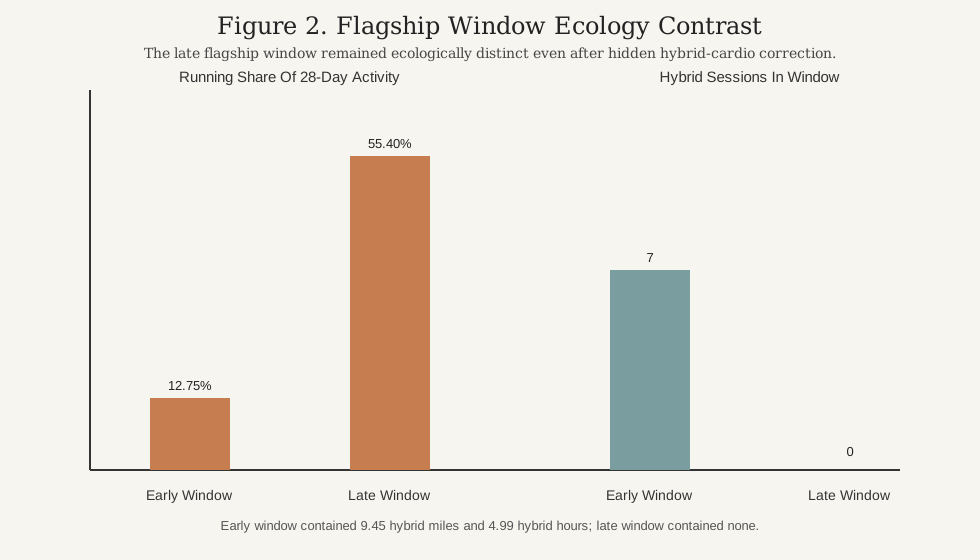
The early flagship window still contained 7 hybrid GPS-bearing cardio sessions totaling 9.45 miles and 4.99 hours, while the late flagship window contained 0.
That matters because the later specialized state was not just running more. It was using a narrower, more specific ecological support structure.
Outside Success Became More Conditional
Low-burden outside expression did not remain broadly available across contexts. It persisted only in supported ecological states instead of across the whole archive.
That keeps ecological narrowing tied to compensation logic and not simple habit drift.
What Study 000M Adds
It Moves Beyond Mechanics Alone
The archive is not only about cadence, stride, burden, and envelopes. It is also about how the activity ecology itself reorganized around constraint.
It Strengthens Compensation Theory
Compensation is no longer only a movement-pattern issue. The data support compensation through ecological organization as well.
It Bridges To Real Life
This is one of the clearest studies showing that adaptation under structural constraint may include narrowing not just how the body moves, but where and how the body can succeed repeatedly.
Plain-Language Summary
This study asked whether the system adapted partly by changing the kinds of training environments and support patterns it used most successfully.
The answer is yes, probably. Running became a much larger share of structured activity, treadmill running became an even larger share of total running, outdoor running became a smaller share, and low-burden outside running only stayed successful in very specific supported states.
The study does not say treadmill is always good, outdoor is always bad, or all support ecology disappeared. The better answer is that the system seems to have reorganized its ecology around the conditions it could use most successfully.
Study Files
Core Reading
Methods and Manuscript
Audit and Outputs
Figures
Figure 01
Ecological narrowing overview.
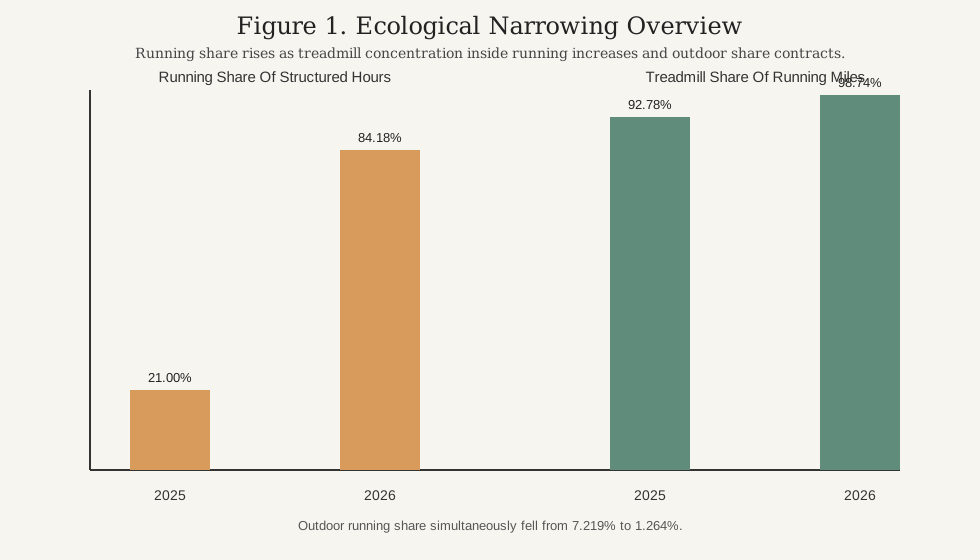
Figure 02
Flagship window versus hybrid-context contrast.
E-E-A-T And Source Context
Author Experience
This page is part of a patient-led altered-mechanics research archive built from one documented case with long-term structural constraint, surgical history, and a multi-year wearable record.
Evidence Boundary
The data are wearable-derived and observational. Study 000M tests whether ecological organization itself appears compensatory. It does not claim universal ecological rules, joint-level biomechanics, or medical causation.
Related Research
FAQ
What is ecological narrowing?
Ecological narrowing means the system increasingly concentrates its successful expression inside a narrower set of environments, support patterns, or activity structures.
Does ecological narrowing mean everything collapsed into treadmill only?
No. The study supports a more specific reorganization, not a total simplification into one activity form with everything else erased.
Why does hybrid support ecology matter?
It shows the system did not simply run more. It also changed how non-running support ecology was used across phases.
Does this study prove ecological narrowing is universal?
No. It supports ecological narrowing in this archive and raises a broader altered-mechanics theory question for future study.
Important Note
This page summarizes a single-subject observational analysis using wearable-derived data. It is not medical advice, not a clinical guideline, and not a substitute for evaluation by a qualified medical professional. The findings describe one documented altered-mechanics archive and should be interpreted within those limits.