Altered Mechanics Flagship Hypothesis Study
Study 000F: Successful Operating Envelope Hypothesis
Home / Research / All Studies / Study 000F
Study 000F asks whether the completed altered-mechanics archive supports the existence of a successful operating envelope, instead of a simple treadmill-versus-outdoor or low-versus-high stabilization-demand explanation.
This study builds directly from Study 000D and Study 000E. Study 000D supported selective expression. Study 000E showed that internal burden rises outside the narrowed successful context. Study 000F tests whether those findings are better explained by an operating envelope: a bounded region of conditions, recent training context, mechanical expression, and burden protection.
The strongest answer is yes. Surface category matters, but it is not enough. The archive is better explained by a successful operating envelope where altered mechanics can express running with lower burden.
Study 000F: Successful Context Is an Envelope, Not Just a Surface
Core Question
Do the findings from Study 000D and Study 000E support a successful operating envelope rather tha a simple treadmill-versus-outdoor distinction?
Core Answer
Yes. Successful running clustered inside a bounded operating region, while burden rose when the system moved outside that supported context.
Why It Matters
Operating envelope is more transferable than a surface label. It can apply to many altered-mechanics systems, not only one diagnosis or one training surface.
Study Purpose
Why Study 000F Was Needed
Earlier studies showed that adaptation occurred, efficiency improved only partially, cadence remained more preservable than stride, and burden increased outside the narrowed successful context.
The next question was whether those findings were simply about treadmill versus outdoor running, or whether they pointed toward a broader construct.
Study 000F tests that broader construct. It asks whether successful expression in altered mechanics is better understood as a operating envelope: a supported range of context, recent training density, mechanical expression, and internal burden behavior.
Plain-Language Finding
The important distinction was not simply “treadmill good” and “outdoor bad.”
The stronger finding is that successful running appeared to happen inside a supportive operating envelope. When the system was well embedded in that envelope, burden stayed lower. When the system moved outside that envelope, burden rose.
That makes the model broader than surface. Surface is one input. It is not the whole explanation.
Primary Result
Operating Envelope Explained More Than Surface Category Alone
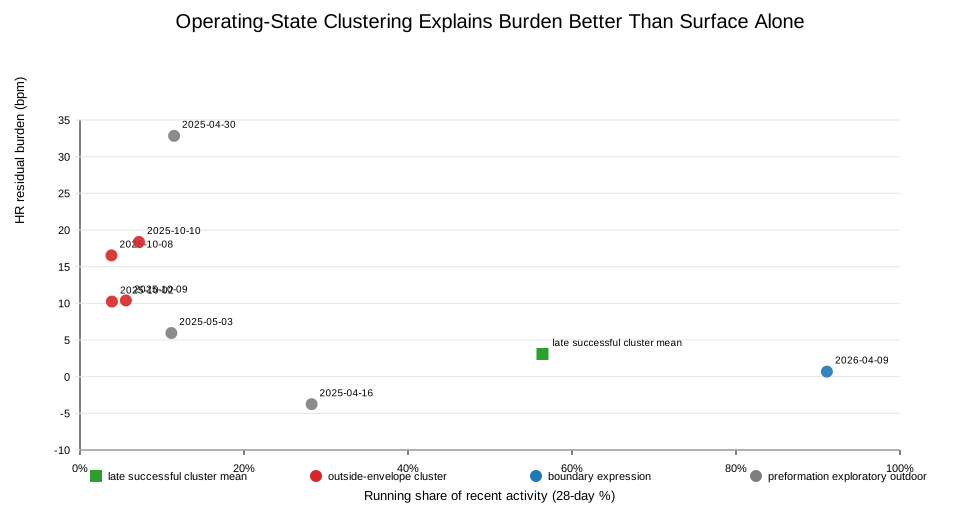
Study 000F found that surface category alone could not organize the archive cleanly. Across outdoor runs, heart-rate residual burden ranged from -3.75 bpm to 32.84 bpm.
That range matters. If outdoor running alone explained the burden story, outdoor runs would behave more uniformly. They did not.
The better explanation is that outdoor surface can push the system toward the edge of the envelope, but the actual burden response depends on whether the run is still supported by recent running context, stabilized embedding, mechanical expression, and training density.
Evidence Family 1
Successful Expression Clustered Instead of Broadening
The later archive did not show broad environmental normalization. It showed narrowed successful expression clustering into a compact operating region.
P5 Running Share
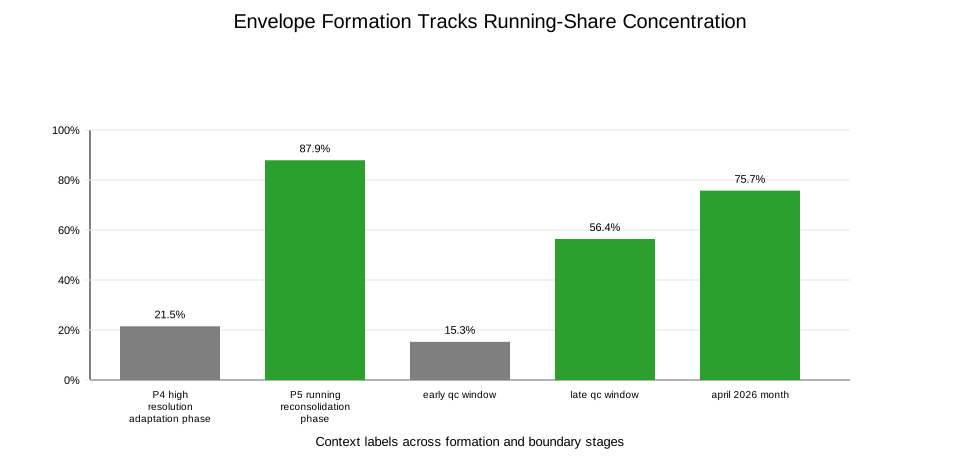
The P5 running reconsolidation phase carried mean running share of 87.90%.
P5 Treadmill Share
Treadmill running share in P5 reached 98.33%.
Late QC Window
Late QC window running share ranged from 50.58% to 62.61%, with mean HR residual burden of 3.09 bpm.
This supports envelope formation. Successful expression became concentrated inside a supported regio instead of becoming broadly normal across all environments.
Evidence Family 2
Burden Rose Near the Envelope Edge
The October 2025 outside-context cluster showed the clearest burden-boundary behavior.
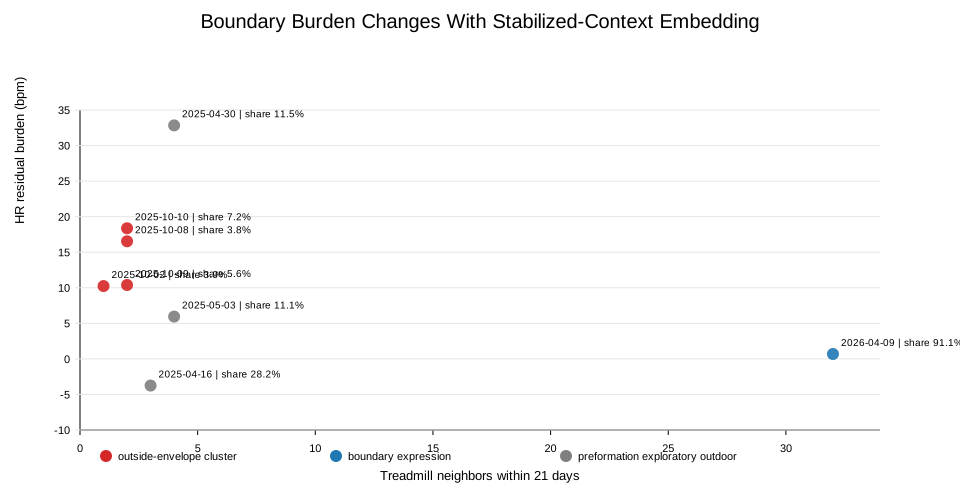
That cluster was not merely outdoor. It was outdoor with thin stabilized embedding, low recent running-share support, and limited treadmill-neighbor density.
Running Share
October 2025 outside-cluster mean running share was 5.13%.
Treadmill Neighbors
Mean treadmill-neighbor density was only 1.75.
HR Residual Burde
Mean HR residual burden was 13.88 bpm.
That pattern supports a meaningful envelope edge: burden rose when the system was outside its narrowed, supported running context.
Key Boundary Case
The April 2026 Exception Strengthened the Envelope Model
The most important case in Study 000F was the April 9, 2026 outdoor probe.
At first, this run looks like an exception because it showed outside-context mechanics but only 0.69 bpm HR residual burden. A simple surface model struggles with that.
The operating-envelope model explains it better. The run occurred while embedded in a highly supported running context: 91.08% running-share context and 32 treadmill neighbors within 21 days. It also sat -3.35 bpm versus matched treadmill mean HR.
In plain language: it was outdoors mechanically, but still supported by the broader envelope.
Evidence Family 3
Surface Was an Input, Not the Whole Construct
Study 000F does not claim surface is irrelevant. Surface clearly matters. But the data did not support treating surface category as the full explanation.
The same outdoor label contained both high-burden and near-zero-burden states. That means the model needed something more precise than “outdoor equals outside successful context.”
The operating-envelope construct allows surface to remain important while also accounting for recent running density, stabilized-context embedding, mechanical expression, and burden response.
Study 000F’s Main Conclusio
The strongest supported conclusion is:
The altered-mechanics archive is better explained by a successful operating envelope than by surface category alone. Successful expression clustered inside a bounded support region, and burden rose whe the system moved outside that region.
Program Meaning
Why Operating Envelope Is a Major Step Forward
Operating envelope gives the research program a broader organizing construct.
Instead of asking whether treadmill is better than outdoor running, Study 000F asks whether an altered-mechanics system has a bounded range where running can be expressed with lower burden.
That idea is more useful because it may apply to many altered-mechanics contexts: joint limitation, surgery history, asymmetry, chronic stiffness, post-traumatic mechanics, restricted range of motion, fusion, arthritis, and other nonstandard movement systems.
Theory Layer
How 000F Changes the Program Model
Study 000D
Established selective expression as the stronger model than broad normalization.
Study 000E
Showed that burden rises when running is expressed outside the narrowed successful context.
Study 000F
Shows that successful context is better defined as an operating envelope than as a simple surface label.
Together, the program now supports a more mature altered-mechanics model: selective expression occurs inside an operating envelope, and burden rises when the system moves outside that supported region.
New Question Created
What Study 000F Opens Next
Study 000F answers whether operating envelope is a stronger explanatory construct than surface alone. But it also creates the next question:
Can envelope support be quantified prospectively using local embedding markers over surface label alone?
That question matters because it would move the operating-envelope model from interpretation toward measurement. If future analysis can quantify the envelope prospectively, the model becomes far more useful.
Research Disclosure
Study Information and Transparency Statement
Study 000F was independently designed, conducted, analyzed, and published by Heath, founder of Clubfoot Forward. It uses the researcher’s own longitudinal activity and running data, along with packaged outputs from the completed Clubfoot Forward altered-mechanics research archive.
No university, hospital, research institution, commercial sponsor, grant funder, or outside organization participated in this work.
Researcher
- Researcher: Heath
- Organization: Clubfoot Forward
- Role: Founder, independent researcher, and dataset owner
- Case context: Adult altered-mechanics system, originating from bilateral congenital clubfoot
Study Design
- Study type: Flagship hypothesis study
- Integrated sources: Study 000B, Study 000D, Study 000E, Microstudy B, Study 000C outputs
- Sample size: n = 1
- Primary frame: Successful operating envelope under altered mechanics
- Status: Completed
Oversight
- Funding: None
- Institutional affiliation: None
- Commercial sponsorship: None
- External oversight: None
- Peer reviewed: No
Read the Study
Study 000F Files
These files are hosted from the public Study 000F archive. Start with the abstract or plain-language summary, then review the manuscript, methods, results, discussion, limitations, and audit materials.
Quick Read
Full Sections
Audit and Replicatio
Figures
Study 000F Figures
These figures summarize operating state burden, embedding versus burden, and envelope formation through running-share context.
Downloads, Source Tables, and Derived Outputs
These files are provided for transparency, inspection, and review. Source tables include packaged outputs from prior studies. Derived outputs summarize the Study 000F successful operating envelope analysis.
Derived Outputs
- Boundary Cluster Summary
- Boundary Expression Table
- Discovered Questions
- Evidence Family Matrix
- Explanatory Power Matrix
- Meta Summary
- Primary Answer
- Scope Claims
- Success Formation Table
Integrated Source Tables
- Study 000B Run-Level Dataset
- Study 000B Monthly Summary
- Study 000B Window Summary
- Microstudy B Outdoor Cases
- Study 000C Claim Stability Matrix
- Study 000D Phase Environment Table
- Study 000D Yearly Expression Table
- Study 000E Burden Summary
- Study 000E Context Burden Summary
- Study 000E Outdoor Probe Details
Interpretation Guide
How Study 000F Should Be Read
It Tests a Construct
Study 000F does not assume the operating envelope exists. It tests whether the archive is better explained by that construct than by surface category alone.
It Is Not Surface-Rejectio
The study does not say surface is meaningless. It says surface is one part of a broader operating envelope.
It Is Transferable in Theory
The model may matter beyond clubfoot because altered-mechanics systems often operate inside bounded functional ranges.
Related Research
Where Study 000F Fits
All Studies
Return to the complete study index for all flagship studies, microstudies, and program synthesis pages.
View All StudiesStudy 000D
The interpretation study that established selective expression as the stronger model than broad normalization.
Read Study 000DStudy 000E
Flagship study showing that internal burden rises when running is expressed outside the narrowed successful context.
Read Study 000EStudy 000C
Full-data synthesis confirming claim stability after HYBRID correction and program reconciliation.
Read Study 000CMicrostudy B
Supporting study examining preserved turnover, suppressed stride, and stride-driven vertical ratio.
Read Microstudy BResearch Hub
Return to the main research center page for the broader mission and archive structure.
Return to Research HubCommon Questions About Study 000F
What is Study 000F about?
Study 000F asks whether successful running in an altered-mechanics system is better explained by a successful operating envelope than by surface category alone.
What is a successful operating envelope?
A successful operating envelope is a bounded range of supportive conditions where running can be expressed with lower internal burden. It may include surface, recent training density, stabilized-context embedding, mechanical behavior, and burden response.
Does Study 000F say treadmill is always better than outdoor running?
No. Study 000F argues that surface is only one input. The April 2026 outdoor boundary case showed that outdoor mechanics can occur with low burden when the run remains supported by the broader envelope.
What was the main finding?
The main finding was that operating envelope explained the archive better than surface category alone.
Is this only about clubfoot?
No. Clubfoot is the originating case context, but operating envelope is an altered-mechanics concept that may apply to other movement systems shaped by joint limitation, surgery history, chronic stiffness, asymmetry, or long-term compensation.
Is Study 000F peer-reviewed?
No. It is a patient-led observational hypothesis study designed for transparency, inspection, and future research question development.
Critical Disclaimer
Study 000F is for education, transparency, and discussion only. It is not medical advice, diagnosis, treatment guidance, clinical gait analysis, peer-reviewed medical research, or population-level biomechanics proof.
This study is a patient-led hypothesis analysis based on available data and lived experience. Findings should not be generalized to all people with altered mechanics, joint limitations, clubfoot (talipes equinovarus, CTEV), gait compensation, stabilization-demand differences, or congenital/acquired lower-limb conditions without larger studies, clinical evaluation, matched comparison groups, and independent review.